
Stereo Imaging Explained: How to Find a Stable Center
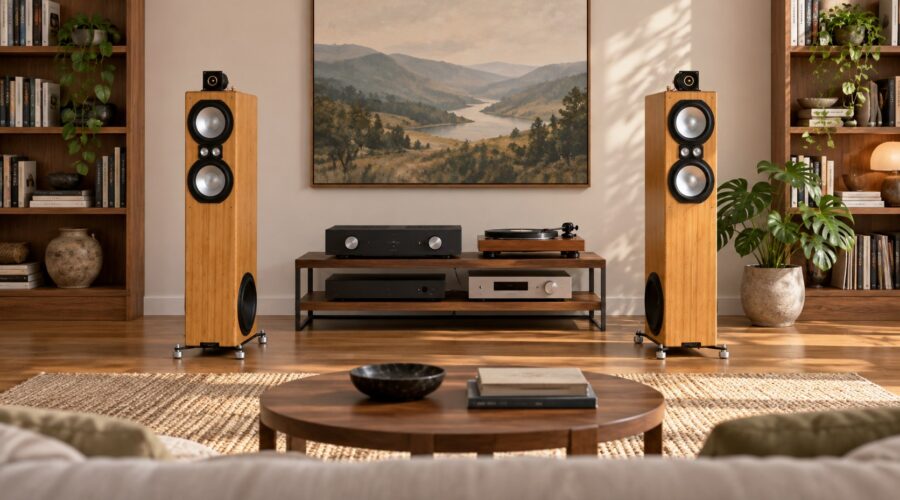
Cover image: concept illustration of a listening space.
Stereo imaging describes how clearly a two-channel system presents the apparent locations of voices and instruments. A singer can seem to stand between the speakers even though there is no loudspeaker in the middle. This is often called a phantom center.
A wide presentation can be enjoyable, but width alone does not tell you whether the system is working well. A useful first test is whether a centered voice remains believable and stable at the main listening seat.
Separate imaging from the recording
Not every recording places a voice in the center, and not every recording aims for a natural acoustic scene. Layered vocals, stereo effects and deliberate panning can make an image move or spread. Start with a familiar recording that you know has a central voice, or use a genuine mono recording.
A mono signal sent equally to both channels gives you a simpler reference. Listen for a focused central source, while remembering that the size of the image still depends on the recording and the room.
Begin with balanced geometry
Measure the distance from each speaker to your main seat. Similar distances are a useful starting point. Keep the speaker pair at matching heights and follow the maker’s guidance for listening height and orientation.
Genelec’s placement guidance emphasizes balanced left and right reflections for accurate imaging. Its studio guidance also uses an equilateral listening triangle as a starting arrangement. Home loudspeaker recommendations can differ, so treat geometry as a testable baseline rather than a universal rule.
Listen before changing several things
- Sit centrally and play your reference voice at a comfortable level.
- Check that balance controls are centered and unintended sound effects are off.
- Note whether the voice is centered, broad, unstable or pulled toward one speaker.
- Make one small position or orientation adjustment to the pair.
- Repeat the same passage and keep notes before trying another change.
Do not judge a change only by how much wider it sounds. Listen for clear words, believable instrument positions and a tonal balance you enjoy. A very wide presentation with a vague middle may be less useful than a slightly narrower but more coherent result.
Investigate a persistent pull to one side
First check simple settings and placement. One speaker might be closer to your seat, partly blocked by furniture or next to a different boundary. A window on one side and an open doorway on the other can also create different reflected sound.
With the equipment powered down, visually check speaker-cable polarity against the amplifier and speaker markings. Follow the manuals and avoid stray wire strands. An incorrectly connected pair can produce an unusual, diffuse presentation. If a channel remains obviously different, ask for help rather than assuming that the room is the only cause.
Check the rest of the sofa
Move to another normal seat and listen again. The phantom center commonly shifts toward the nearer speaker as you move away from the middle. That is a practical feature of two-channel listening, not proof that a product is defective.
Decide what matters most for your household: a precise central seat, enjoyable music across several seats, or a balance of both. Include that preference when discussing a new system. A demonstration should reflect how you will use the speakers at home.
Bring an imaging test to an audition
Use the same short voice and acoustic-instrument passages during a speaker audition. Keep level and seating position consistent before comparing impressions.
Explore the Sofia 104 or Bache Audio speaker range, then arrange a listening appointment to hear available models.
Does every song need a pinpoint center?
No. Some productions intentionally create broad or moving images. Use a known reference to check the system, then enjoy each recording on its own terms.