
4-Ohm vs 8-Ohm Speakers: What Your Amplifier Needs
Cover image: explanatory diagram; not a product measurement or model-specific setup recommendation.
A 4-ohm or 8-ohm label describes the electrical load a speaker presents to an amplifier. It does not rank sound quality, tell you how much bass a speaker produces, or guarantee that two products will work well together. The useful question is whether your amplifier can drive the exact speaker configuration you plan to use.
This guide focuses on passive Hi-Fi speakers connected to a separate amplifier. Powered speakers with built-in amplification have different connection requirements.
Nominal impedance is a starting point
Impedance, measured in ohms (Ω), varies with frequency. A nominal rating summarizes a changing load rather than describing a fixed resistor. An 8-ohm speaker can have a lower minimum impedance, so the minimum figure or an impedance curve can add useful context.
Start with the manufacturer’s current specifications for the exact model and revision. If the minimum is not published, ask the speaker maker which amplifiers and operating conditions it recommends. Avoid using a cabinet’s size or driver count to guess its electrical demands.
Why a lower load asks more of the amplifier
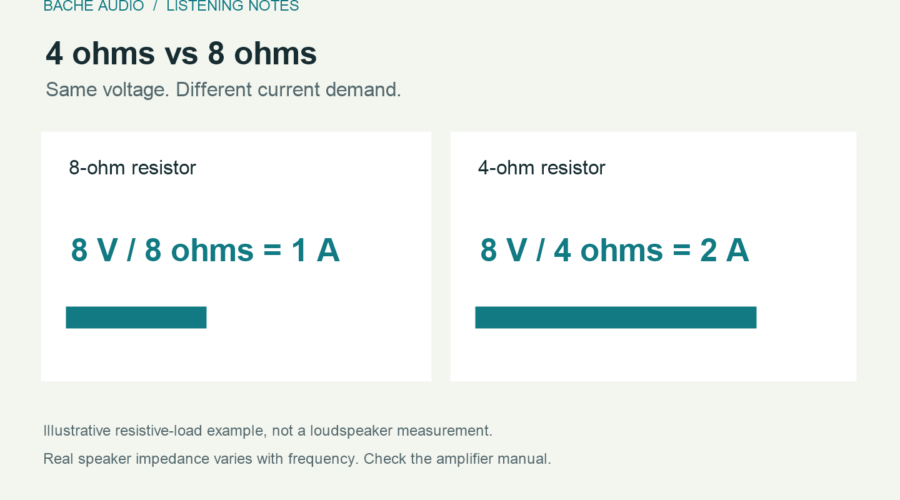
At the same output voltage, a lower resistive load draws more current. As a simplified example, 8 volts across an 8-ohm resistor produces 1 ampere; across 4 ohms it produces 2 amperes. A real loudspeaker is a more complex load, but the example explains why a 4-ohm rating deserves attention.
This does not mean that every amplifier doubles its usable power when impedance halves. Its power supply, output stage, protection system and operating conditions set practical limits. Compare manufacturer ratings under comparable test conditions rather than assuming that a larger wattage number resolves every compatibility question.
Read the amplifier’s connection instructions
Find the manual for your exact amplifier. Check its permitted speaker load for the output mode you will actually use. A stereo power rating into 8 ohms is not, by itself, approval to connect any lower-impedance speaker.
- For a solid-state integrated amplifier, check the supported load and any manufacturer instructions for an impedance setting.
- For a tube amplifier with output taps, follow its instructions for the speaker terminals and load. Do not choose taps by a generic internet rule.
- For bridged or mono operation, read that mode’s separate limits. Stereo limits may not apply.
If the documentation is unclear, give the amplifier maker the speaker’s nominal and minimum impedance. The model names matter more than a description such as “a powerful amp.”
A+B outputs need a separate check
Two sets of binding posts do not necessarily mean two independent power amplifiers. On designs that connect A and B speakers in parallel, playing two nominal 8-ohm speakers on one channel creates a nominal 4-ohm combined load. Different wiring or switching arrangements require different treatment.
Check the manual before running two pairs together. Cambridge Audio and Marantz both document model-specific requirements for this situation. A speaker-selector box also needs to be used within its stated limits; its presence does not automatically make an unsupported combination suitable.
Impedance and sensitivity answer different questions
Impedance concerns electrical loading. Sensitivity describes acoustic output for a stated input and measurement setup. Read our speaker sensitivity guide before comparing dB figures quoted at different voltages or powers.
Your listening distance, preferred level and room also affect the system you need. A sensible shortlist combines electrical compatibility with a listening session at realistic volume. Our speaker and amplifier matching guide covers the wider decision.
A checklist to send before buying
- The exact amplifier model, operating mode and manual.
- The speaker model and published nominal/minimum impedance.
- Whether you intend to play one pair or two pairs at once.
- Your approximate listening distance, room layout and usual volume.
When changing speaker wiring, switch off and disconnect equipment as instructed by its manufacturer. Keep stray wire strands clear of adjacent terminals. Repeated protection shutdowns, unusual heat or audible distortion are reasons to stop and investigate rather than increase the volume.
Discuss your Bache Audio setup
Contact Bache Audio with your amplifier model and the speakers you are considering. You can also browse the current collection and confirm compatibility for the exact model before ordering. No single impedance label replaces that check.
Technical references
For background, see Focal’s explanation of speaker impedance, Cambridge Audio’s guidance on two speaker pairs and the Marantz PM5005 connection instructions. These illustrate general principles and model-specific limits; they do not certify another amplifier or Bache Audio model.