

A Visit to Bache Audio – SoundStage
Located in Brooklyn, New York, Bache Audio mostly manufactures audiophile speakers. On July 5, 2020, Greg Belman, Bache’s founder, invited me over for a listening session. It was my first face-to-face audio meeting since the global pandemic’s start.
I first met Belman several years ago when I attended a demonstration of Bache’s speakers at the New York-based Audiophile Society. At that demo, the speakers were successfully paired with tube electronics from Alexus Audio. Belman is good friends with Alexus’s founder, Alex Chorine, and as discussed below, the two have collaborated professionally. Although both Belman and Chorine are formerly from Russia, the two didn’t meet until they came to the United States.
When I arrived, Belman greeted me at curbside. After some catching up on the busy city street, Belman and I headed to Bache’s showroom, behind which lies a small product assembly area.

Greg Belman
Bache is a one-man operation. As such, Belman handles all of the company’s activities, save for some heavy physical work that his son handles. Belman came here from Orenburg, Russia, an old fortress city that lies on the Ural River, about 900 miles southeast of Moscow. When in Russia, Belman worked as an electrical engineer at a top-secret military manufacturing facility. When I asked him what types of things he worked on, he told me that although he had intimate knowledge of the devices that he designed, he wasn’t privy to the types of end products they were used in. I took him at his word.
Belman told me that around 2010, he began designing and building single-driver speakers. These speakers don’t exhibit the reported driver cohesiveness problems that can be associated with speakers employing multiple drivers, and thus one or more crossovers. I advised Belman that designing a single-driver speaker seems very difficult, since that driver needs to cover the entire frequency band. He agreed, stating that one problem with such speakers is that they perform poorly at the frequency spectrum’s upper and lower ends. Belman further stated that he tried adding a tweeter to his early speaker models, but he got poor top-end results. He also tried pairing the speakers with subwoofers, but he found that a suck-out in the upper bass to middle-midrange region of about 100 to 500Hz caused voices and instruments such as piano and cello to sound thin.

What Belman ultimately gravitated toward was the so-called “augmented wide-band” (AWB) speaker, which uses a single wide-band driver that covers a large portion of the audible frequency band, accompanied by several of what he calls “helper” drivers, in this case a super tweeter and one or more woofers. Belman said that this hybrid design incorporates the best attributes of the one-way designs (exceptional dynamics and coherence) and their three-way counterparts (excellent frequency extension and dispersion characteristics, along with the ability to play loudly without distorting).
People who heard Belman’s AWB speakers were impressed. In fact, he soon developed somewhat of a cult following. In 2013 Belman started Bache. The company’s current speaker models, made in small runs, range in price from $2500 to $14,000 per pair (all prices USD).
The small 225 sq. ft. showroom had a ceiling that was at least 10’ high. Its audio system, which Belman also uses to voice his speakers, consisted of a Cocktail Audio X50(D) music server and a 500W AB Audio class-D integrated amplifier. AB, named from the first letters of “Alexus” and “Bache,” is a joint venture between those two companies.

The room contained many Bache AWB speakers. However, the ones Belman most wanted me to hear were the Lexington-001 and Tribeca-001 speakers ($3700 and $5600 per pair, respectively).
The Lexington-001, rated at 90dB sensitivity, is designed for small-to-medium-sized rooms, perhaps one in an urban apartment. It has a 1″ AMT (air motion transformer) super tweeter, 4″ W4-1320 Tang Band full-range driver with a paper-bamboo-blend cone and underhung 1″ voice coil, and two 5.25″ Eton woofers that each feature a nonwoven carbon fiber and Kevlar composite cone. As several other speaker designers have done before him, Belman removes the Tang Band’s whizzer cone, which is a small secondary cone that radiates high-frequency sound more effectively than does the larger one. Belman feels that if left intact, the whizzer cone colors the sound.

Lexington-001
Belman said that the Tribeca-001, rated at 92dB sensitivity, is a good match for somewhat larger rooms and works well with a wide range of amplifiers, including many tube amps. It uses an expensive Japanese-made Fostex super tweeter, an 8″ model W8-2145 Tang Band full-range driver with a bamboo-fiber-reinforced paper cone and underhung 1.5″ voice coil, and two 8″ Eton woofers.
Both the Lexington-001 and Tribeca-001 speakers are ported. They’re also minimally designed, using one pure copper capacitor per speaker to protect the super tweeter and one inductor coil to prevent high-frequency signals from being fed to the woofers. The speakers’ cabinets are constructed from MDF, which Belman can finish in virtually any color at no additional cost, and a wide variety of finishing materials. The pair of Lexington-001s that we listened to were tastefully bedecked in a red faux leather. The Tribeca-001s, also no slouches, sported a gorgeous piano-white finish.

Tribeca-001
Although we didn’t get a chance to listen to them, the showroom also contained numerous high-sensitivity Bache AWB speakers that were designed for extremely large rooms, though they’re said to pair very well with even flea-watt amps. One such speaker was the Bache Audio 002AB ($12,500 per pair), which is rated at 96dB sensitivity and contains two 10″ woofers, one powered and one passive.
When it was finally time to listen, I focused on whether the “helper” drivers assisted the Lexington-001 and Tribeca-001 speakers in doing things that many traditional single wide-band speakers have trouble with — playing at loud volumes without distorting, producing a wide dispersion pattern, and excelling with both intimate acoustic music tracks and more complex ones, perhaps with substantial high-frequency content and low-end slam and impact.
The demonstration tracks included numerous intimate recordings such as Ella Fitzgerald’s “My Reverie,” from Clap Hands, Here Comes Charlie! (Verve Records), and Jheena Lodwick’s “A Groovy Kind of Love,” from Best Audiophile Voices V (Premium Records). However, also included were large-scale orchestral works with extended dynamic swings, transient-laden grand tuttis, and thunderous bass drum strikes. Examples of the latter works were selections from Dmitri Shostakovich’s Symphony No.9, Op.70 and Sergei Prokofiev’s Lieutenant Kije Suite, Op.60, conducted by Malcolm Sargent and performed by the London Symphony Orchestra (Everest Records).

With both the Lexington-001 and Tribeca-001 speakers, Ella Fitzgerald’s voice was gorgeous, natural, relaxed, and coherent throughout her range. At many times the Baches’ cost, the very best dynamically driven speakers use crossovers that are eloquently designed to deliver this type of performance and more. Those much more expensive speakers also deliver even more detail than that provided by the Baches. However, the Baches made the reproduction of Ella’s voice by their price-appropriate competitors seem rough and jacked-up with unwanted energy.
Assumedly due to the helper drivers, the Lexington-001 and Tribeca-001 speakers had no problem playing at loud volumes. Even at such volumes, percussive strikes on “A Groovy Kind of Love” were punchy and articulate. The tuttis and bass drum attacks in the above London Symphony Orchestra movements were jarring in a good way. Also, assumedly due to the assistance of those drivers, there was no problem at the frequency extremes. Walking around the room while music was playing revealed good sound everywhere despite the removal of the Tang Band’s whizzer cone.

Finally, I needed more time with the Lexington-001 and Tribeca-001 speakers to make a definitive determination as far as sonic colorations. Any darkish colorations I detected were slight and pleasing, and they never subtracted from my listening enjoyment. There are competitor speakers that are more conventionally designed, but they might not produce the gorgeous midrange bloom and easy-to-listen-to and relaxed sound that the Baches do.
All speakers make sonic compromises. The ones made by Bache’s Lexington-001 and Tribeca-001 speakers, which favor a gorgeous midrange and excellent cohesiveness and perceived dynamic range, will appeal to many. So it’s no surprise that Bache’s augmented and modified wide-band dynamic-driver speakers have garnered a cult following. If more audiophiles give them a listen, the cult may be headed for a substantial membership expansion.
Howard Kneller
Senior Contributor, SoundStage!

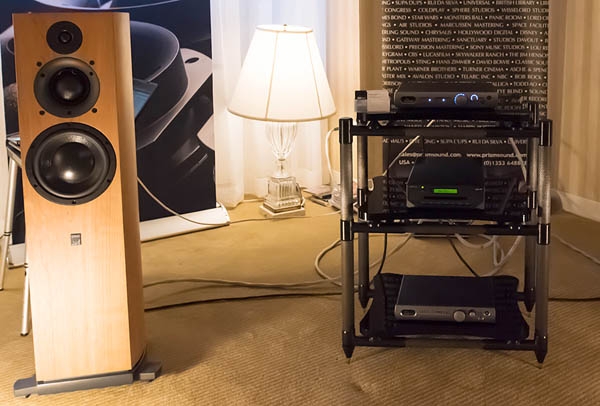 I don’t get out much. In particular, I don’t normally go to audio shows. But this weekend I attended the New York Audio Show, which was held at the Park Lane Hotel, on the south end of Manhattan’s Central Park—just a short subway ride (followed by a shorter walk) from my New York apartment. It was pleasant enough, I suppose, but also a good reminder of the reasons I don’t usually go to audio shows. Reason # 1: There are people there. People who aren’t me. With opinions. Reason # 2: A hotel is a lousy place to demonstrate a fine audio system. Some clichés are true, as was apparent in the first room I walked into, the Prism Sound room, where the company’s $2750 Callia DAC/preamp/headphone amplifier was being demoed with a pair of ATC SCM 40A active monitors, a computer running JRiver, and some cables. The room was small, approximately square, with low ceilings, and—like all the rooms I visited at the show—very yellow. Prism’s Mark Evans told me they’d set up the room three times and torn it apart twice; they ended their work with the speakers firing diagonally across the room, with big bass traps in corners and some sound-absorbing panels at reflection points. The resulting sound was good, not great: rich and full with a soundstage of some depth and adequate width, but a bit fuzzy. The room made it impossible to judge the Callia’s sound, but the company’s history makes the DAC interesting by default. Prism has long been an established leader in the pro-audio world, but the British-made Callia—the name means “beautiful voice” in Greek—is their first consumer DAC. The Callia has all the usual inputs and natively handles PCM up to 192/24; it can play files up to 384/32, but it decimates these higher resolutions down to 192/24, which should not affect sound quality. The Callia handles DSD, too, via its USB input, but it’s a PCM-centric DAC: DSD must first be converted to DoP (DSD-over-PCM) and then is converted to PCM internally. Anyone who feels, as I do, that a pro heritage is a good thing in a source component, should consider adding the Callia to their audition list.
  The problem with hotel rooms, though, isn’t limited to sound. It includes smell. The second room I entered—after Prism Sound—was the Wes Bender Studio NYC room. When I got to the room, Wes was busy dealing with hotel staff, seeking a way to deal with the room’s smells; it seems likely that the toilet had overflowed not too long ago, soaking the carpet. Wes had retrieved a bottle of carpet cleaner and was preparing to soak the carpet. The Wes Bender room had a Danish theme; it featured GamuT everything, with a tiny bit of Ortofon. The lovely stand-mounted speakers were GamuT’s RS3i ($20,990/pair); they were spaced widely along the narrow room’s long wall. Electronics were the GamuT D3i dual-mono line-level preamp ($8380), the D200i dual-mono stereo preamplifier ($13,990), and a CD3 CD player ($7990). Cabling was from GamuT’s Reference series. The Ortofon touch was a step-up transformer sitting on the big (42″) Stillpoints ESS rack ($10,700). The analog source was the lovely Slovenian-built—and Stereophile A-rated—Pear Audio Blue Kid Thomas Turntable ($7995 with their Cornet 2 tonearm), assisted by the company’s Blue Classic phono stage ($1995) and external power supply ($2000). The cartridge was a Transfiguration Proteus. These widely spaced, smallish, stand-mounted speakers presented a big stage, whether it was the Kiki Dee band on CD (an inspired choice for an audio show—definitely not the same ol’ same ol’) to McCoy Tyner’s New York Reunion LP on Chesky Records. Images were, as you would expect with this speaker geometry, big and broad if perhaps not as solid as they would be with speakers closer together, but this is a good example of working with the room instead of fighting it. Reason #3: The music. While I was in the Prism Sound room, music by pianist/composer Hiromi was playing. Hiromi’s okay, but there are better things to listen to—like, say, classic jazz on a well-kept old LP (or a good CD for that matter), or maybe something new and good. Two of the next three rooms played Diana Krall. In one room, an attendee interrupted some decent tunes to put on his favorite 1812 Overture CD—who listens to this stuff? Pop orchestral favorites such as Manuel de Falla’s The Three-Cornered Hat (with the annoying piccolo) and Rachmaninoff’s Symphonic Dances were abundant—but where were the concertos and the chamber music? It’s no one’s fault, really. It’s not, I’m thinking, that anyone really loves this music—although perhaps I overestimate audiophiles. It’s like politics: Everyone has their own ideas, so you end up with the lowest common denominator, music no one especially likes but no one despises. The Replacements would probably offend 2/3 of the people in the room, Bad Brains 90%. Still, some choices are hard to fathom: Why isn’t there more classic jazz? Why no late-period Duke Ellington or Count Basie? Aren’t some of those recordings are show-worthy? It’s all the more reason to stay at home and listen to whatever I want to. I don’t ask for much. If I’d even heard, say, some Pink Floyd or a nice Grateful Dead live groove, I might have put down a sleeping bag and stayed the night—which, come to think of it, might be another reason not to play good music at audio shows.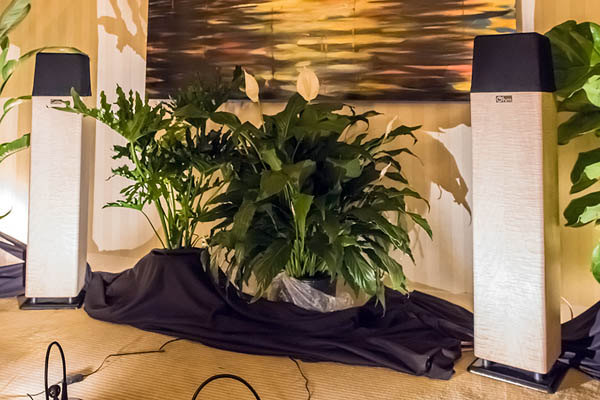
 My experience in the Ohm room led to an insight: ambience is overrated. It’s also one of the hardest things to get right. I think what happens is this: ambience captured on recordings gets mixed up with the ambience of the listening space, causing spatial-aural confusion. It’s a conspiracy of room, speaker, and recording, each contributing something to the chaos. I find myself trying, as I did in the Ohm room, to listen through, not to, the ambience. Better to have slightly rolled-off highs, in my view, than to have more extended highs. Ambience becomes noise in much the same way that a flower growing in the wrong place is a weed. This was not a problem in the room presented by New Jersey-based dealer The Art of Sound because of the imposing Sonus Faber Amati Futura loudspeakers. This was another long, narrow room with equipment set up along the long wall. This room didn’t have that high-end problem—which made sense after I read
 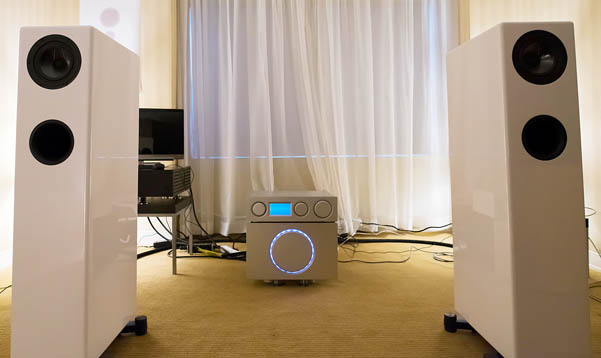 The room hosted by Connecticut-based Laufer Teknik featured the big, perfect-looking Ascendo D9 loudspeakers ($13,750/pair) and electronics—as pretty as the speakers and a great visual match—from Behold: the BPA 768 stereo amplifier and the APU 768 stereo preamp with built-in DAC (prices not specified). In this small room, the big D9s were set up so close together that I doubt you could have laid another B9 on its side in between them, probably to keep them away from the side walls. I’m sure these big boys are capable of bigger sound, but in this modest setup the sound was very good. When I saw a picture on the NY Audio Show website of Laufer Teknik’s Memory Player Mini ($2495), I assumed there was a mistake: The picture was of an NUC, a tiny Intel-based computer that you can buy at most electronics stores. I have one at home. My NUC, which I use as an audio server, running Roon, sounds just fine. But if Laufer’s enhancements improve the sound substantially, it could be well worth the price. It was impossible to tell under show conditions whether it does or doesn’t, but I’m hoping to try out these enhancements on my own NUC.
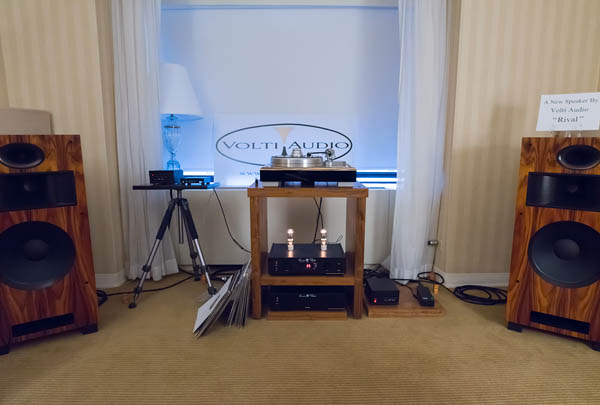 My award for Most Surprising Sound goes to the Vinnie Rossi/Fidelis AV room, where the smaller (but still imposing) Volti Audio horn loudspeakers—the Rivals—belied their big (41.5″ x 19″ x 16″), aggressive-looking boxes and modest price (starting at $7900/pair) with surprisingly intimate sound, via amplification from Vinnie Rossi: the VR120 Stereo Power Amplifier ($4995) and the modular LIO Integrated amplifier, with direct-heated triode line stage, DAC, and phono-stage options ($10,280 as configured). Ricky Lee sang from the Show Biz Kids LP via an Acoustic Signature Triple X turntable with a TA-2000 tonearm and the Dynavector XX2 Mk.II cartridge ($5795, $2399, and $1995 respectively). The big bass excited some room (and possibly speaker) resonances, but overall it had good texture. Read more at http://www.stereophile.com/content/nyas-2016-day-one-jim-austin#z991IouMgPT8PWAZ.99