
Speaker Toe-In: A Step-by-Step Listening Test
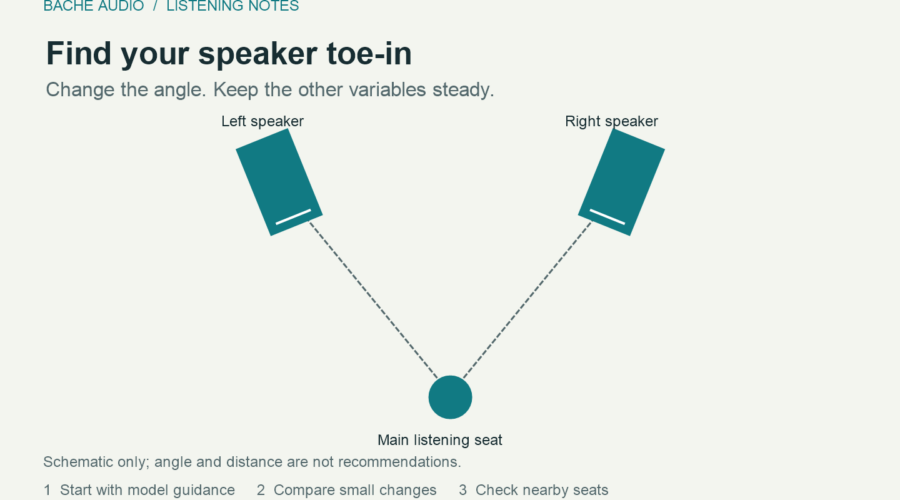
Cover image: explanatory diagram; not a product measurement or model-specific setup recommendation.
Speaker toe-in means rotating the left and right speakers inward toward the listening area. It changes the angle at which you hear each speaker and can affect tonal balance, the apparent position of voices and the experience from nearby seats. There is no universal angle that suits every speaker and room.
This guide gives you a repeatable test for a two-channel system. Begin with the speaker maker’s setup instructions, then use small changes to find a result that suits the way you listen.
Separate rotation from speaker placement
Toe-in is a rotation adjustment. Moving a speaker closer to a wall, changing the distance between the cabinets, or moving the sofa changes other variables. Establish a reasonable layout first, including stable supports and the listening height recommended for your model.
Measure from the same reference point on each cabinet to the main seat. Aim for a balanced starting layout where practical. If one side faces a large opening and the other sits beside glass, write that down: rotation cannot make two different surroundings identical.
For the broader layout, read our speaker placement guide. The exercise below changes only the horizontal angle.
Start with the manufacturer’s recommendation
Some speakers are designed to work well facing forward; others are intended to aim toward the listener. For example, KEF’s setup guidance begins with no toe-in for its own designs, while Genelec’s monitoring guidance aims the acoustic axes toward the listening position. Neither instruction is a universal prescription for a different product.
Use the current guidance for your exact Bache Audio model as your baseline. If you do not have an angle recommendation, ask for one rather than assuming every cabinet should point directly at your nose.
Prepare a short, repeatable playlist
Choose a familiar centered voice, a recording with sustained acoustic instruments and a busier track you often enjoy. Keep the same recording version, amplifier settings and comfortable playback level throughout. Turn off shuffle so each comparison uses the same short passage.
A mono voice played through both speakers can help you assess a center image. It is a listening aid, not a measurement of the speaker’s frequency response. If a voice leans strongly to one side, first check balance settings, channel operation and the symmetry of your seat.
Compare three useful positions
- Baseline: listen at the recommended angle. Note the voice position, tonal balance and how easily you follow individual instruments.
- Slightly more inward: rotate both speakers inward by a small, similar amount without intentionally changing their locations. Replay the same passages.
- Slightly less inward: return to the baseline, then try a small outward adjustment. Compare again before deciding.
Use removable position markers only if they are suitable for your floor finish. Measure rather than rely entirely on how the cabinets look from the sofa. A phone angle tool may help repeat a position, but it is not a calibrated acoustic measurement.
Listen for a combination of results
A more sharply focused voice is useful only if the overall presentation remains comfortable. Listen for believable vocal size, clear musical lines and a tonal balance you enjoy. Avoid selecting an angle solely because one percussion hit sounds more prominent.
If you want a clearer description of the phantom center, see our stereo imaging guide. Toe-in may alter that impression, but it cannot fix every source, channel-balance or room problem.
Check the seats you actually use
After choosing a preferred angle from the main seat, try the adjacent sofa positions. Note whether voices remain easy to follow and whether the sound becomes uncomfortable or uneven. A setting chosen for one chair may not be your preferred compromise for two listeners.
For a shared room, compare the main seat and another regularly used seat before accepting the result. Our open-plan listening-room guide discusses the layout constraints that often accompany a wider seating area.
Know when to stop adjusting
Return to familiar music for a longer session. If two small angle changes are difficult to distinguish, keep the simpler arrangement and record it. You do not need an exact degree figure to enjoy the system.
If the same notes remain boomy or disappear in every position, investigate speaker/listener distance from boundaries and room acoustics separately. Keep a record of each change so you can reverse an experiment that makes things worse.
Get advice for your room
Send Bache Audio your model, room sketch and listening distance for setup guidance. If you are comparing speakers, prepare for a listening visit and ask how the demonstration setup relates to your own room.
Further reading
See KEF’s speaker setup guidance and Genelec’s monitor-placement guide for manufacturer-specific approaches. The listening worksheet above is a practical comparison routine, not a claim that those products share Bache Audio’s dispersion or preferred setup.