
Low-Volume Hi-Fi Listening: How to Keep Music Engaging
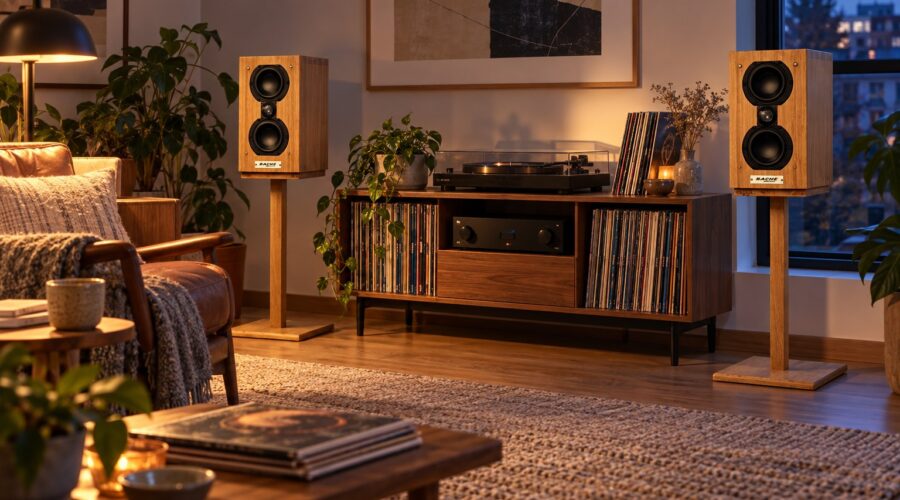
Cover image: concept illustration of a listening space.
Low-volume Hi-Fi listening should make it easy to follow a voice, a melody and the rhythm without constantly reaching for the volume control. If music feels thin in the evening, the answer is not automatically a larger amplifier or a new pair of speakers. Start by separating changes in hearing, room noise and system behavior.
This guide offers a repeatable way to improve quiet listening with the equipment you already own, then identify what to test during your next speaker audition.
Why music changes when you turn it down
At lower playback levels, bass and high-frequency detail can seem less prominent relative to the midrange. That does not necessarily mean the speaker has stopped reproducing those frequencies. Our perception of tonal balance changes with level. Yamaha explains this principle in its guide to loudness compensation.
A loudness function, where available, can help compensate. Follow the instructions for your particular amplifier: a variable loudness control may work differently from a simple on/off button. Compare the result at your actual evening listening level and avoid assuming that the same setting will suit louder playback.
Lower the noise around the music
Listen to the room with playback paused. A running extractor fan, computer or open window can hide quiet musical details. Reducing an avoidable noise source may help more than changing an audio component.
Also distinguish room noise from system noise. A hiss audible only with your ear close to a tweeter is a different observation from a hum clearly audible at the sofa. If there is an obvious new noise, note which input is selected and ask for troubleshooting advice. Do not open equipment or remove electrical safety connections.
Check volume control and channel balance
Play a familiar centered vocal and reduce the level gradually. Does the voice stay between the speakers? If it pulls to one side only at the very bottom of the volume range, investigate the amplifier’s volume-control behavior before changing speaker position.
Use your source and amplifier as their manuals recommend. When several devices offer volume adjustment, establish a predictable everyday control rather than repeatedly changing every stage. Start low after any configuration change, since different inputs can have different output levels.
Make a simple quiet-listening comparison
- Choose one familiar vocal recording and one track with an easy-to-follow bass line.
- Set your usual evening volume and sit in your normal position.
- Listen with tone or loudness processing bypassed, then compare one supported adjustment.
- Keep perceived loudness similar when comparing settings.
- Write down whether the music is easier to follow, rather than simply fuller or brighter.
Keep speaker placement practical and repeatable. A slightly closer listening position may be worth trying if your room allows it, but it does not replace good placement or eliminate sound travelling to neighbors. Avoid boosting deep bass simply to recreate the physical impact of loud playback.
Audition speakers at the level you use
Bring this test to a Hi-Fi speaker audition. Ask for time at quiet levels instead of judging only an impressive demonstration. Consider amplifier noise, channel balance and the whole system, not a single specification.
Explore the Bache Audio Sofia 101 and the speaker collection, then contact Bache Audio to discuss your room and arrange a listening appointment in Brooklyn.
Common questions about quiet listening
Does higher speaker sensitivity guarantee better quiet sound?
No. Sensitivity describes output for a stated input. Quiet-listening quality also depends on tonal balance, room noise, the recording and the electronics.
Should I always use loudness compensation?
No. Try it only if your equipment offers it, follow its instructions and keep the setting that helps at your preferred volume.