
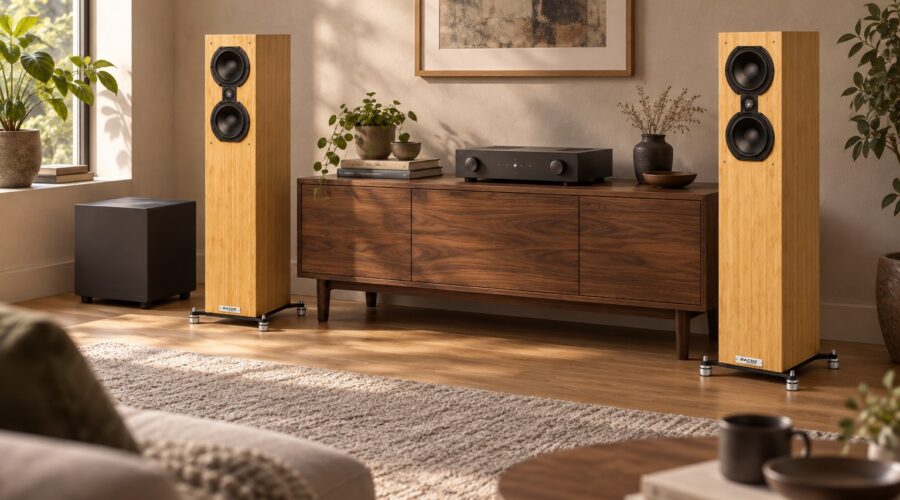
Do You Need a Subwoofer for a Stereo Hi-Fi System?
A subwoofer for stereo can be useful when you want deeper bass than your main speakers can comfortably provide. It is not a required accessory for every Hi-Fi system. The decision depends on your speakers, listening level, room, and the music you enjoy.
Before adding one, identify the problem you want to solve. Missing low notes, uneven bass across the room, and excessive boom are different issues and may need different approaches.
Start with the bass you already have
Listen to a few familiar recordings with clear bass lines. Can you follow the notes? Does one pitch dominate while another seems weak? Does the balance change substantially when you move to another seat?
Write down those observations before changing equipment. A system that sounds full in one position and thin in another may have a placement or room interaction problem. Adding more bass output without addressing that pattern can make the result less consistent.
When a subwoofer may help
Consider a subwoofer if your speakers leave the lowest part of your preferred music underrepresented, or if you want more low-frequency output than they can comfortably deliver. Compact speakers are one common application, but cabinet size alone does not decide the answer.
Floorstanding speakers can also work with a subwoofer. Equally, a well-matched pair of main speakers may already provide the extension and level you want. Compare the complete system against your listening goals rather than assuming a larger equipment list is better.
Check connections before choosing a model
Look for the outputs supported by your amplifier and the inputs supported by the subwoofer. A dedicated subwoofer output, a variable preamplifier output, and a manufacturer-approved high-level connection are different arrangements.
Follow the manuals for the exact equipment. Do not improvise a speaker-level connection to a line-level input. Ask for connection advice if either manual leaves compatibility unclear, particularly with unusual amplifier output arrangements.
Understand the crossover
A subwoofer’s low-pass filter limits the upper frequencies it reproduces. A high-pass filter reduces low-frequency content sent to the main speakers. Simply connecting a subwoofer does not automatically high-pass the speakers or reduce their bass workload.
The crossover settings should suit the main speakers and the available bass-management system. There is no single frequency that is ideal for every stereo setup. For a technical overview of low-pass and high-pass behavior, see SVS’s guide to subwoofer DSP.
Allow time for placement and adjustment
Place the subwoofer where it can work acoustically as well as fit physically. Its best location may differ from the best position for your main speakers. A corner can provide stronger bass, but stronger does not always mean more even at your seat.
Try a few feasible positions and compare the same passages from your usual listening place. SVS’s subwoofer placement guide explains why room position affects the result. Change one variable at a time so you can identify what helped.
Start with a modest subwoofer level. Adjust level, crossover, and phase according to the equipment instructions, then revisit several recordings. The aim is a convincing blend rather than a separate source of bass that attracts attention on every track.
Make the decision with a short checklist
- What low-frequency limitation do I hear in my current system?
- Have I tried practical changes to speaker and seat positions?
- Which compatible connection will I use?
- Does my system provide high-pass filtering, or will the main speakers remain full-range?
- Where can the subwoofer realistically stand?
- Can I evaluate the result at my normal listening level?
Keep your answers when comparing options. They help separate a useful upgrade from an additional box that leaves the original problem unresolved.
Build a balanced stereo system
If you are choosing your main speakers first, explore the Bache Audio speaker collection. To discuss how a particular model fits your room and existing electronics, contact Bache Audio with your equipment details and listening goals.
Common questions
Is a subwoofer only useful for movies?
No. It can reproduce low-frequency content in music too. Whether that adds value depends on the recordings, main speakers, setup, and your preferences.
Will a subwoofer fix boomy bass?
Not automatically. First investigate placement, room effects, and level settings. More output by itself does not correct an uneven response.