

Audiogon Discussion Forum: Capital Audio Fest Notes
Bache Audio
Bache Speakers
AB Audio (stands for Alexus/Bache, bad idea for trying to Google) Class D integrated
This room just made music. So enjoyable to listen to with no exaggeration of any frequencies. I heard the floorstanding Urban-002 and the standmount Sonata-EX. I couldn’t believe when I sat down on Saturday (3rd visit I believe) and saw the Sonata’s were playing. I don’t think I’ve heard a speaker sound this good for the price. The amp/speaker combo was like $4500 on show special. They will be super easy to setup and can be 6 inches from the wall or way out according to Greg, the owner. I may get a pair just because. They’re that inline with my tastes. I would bet sound of the amps may not matter as much with these as other speakers (just a guess). Harbeths are similar in that amps don’t matter quite as much. It’s all going to sound good it’s just a matter of what flavor you’re looking for.
From here: https://forum.audiogon.com/discussions/capital-audio-fest-notes

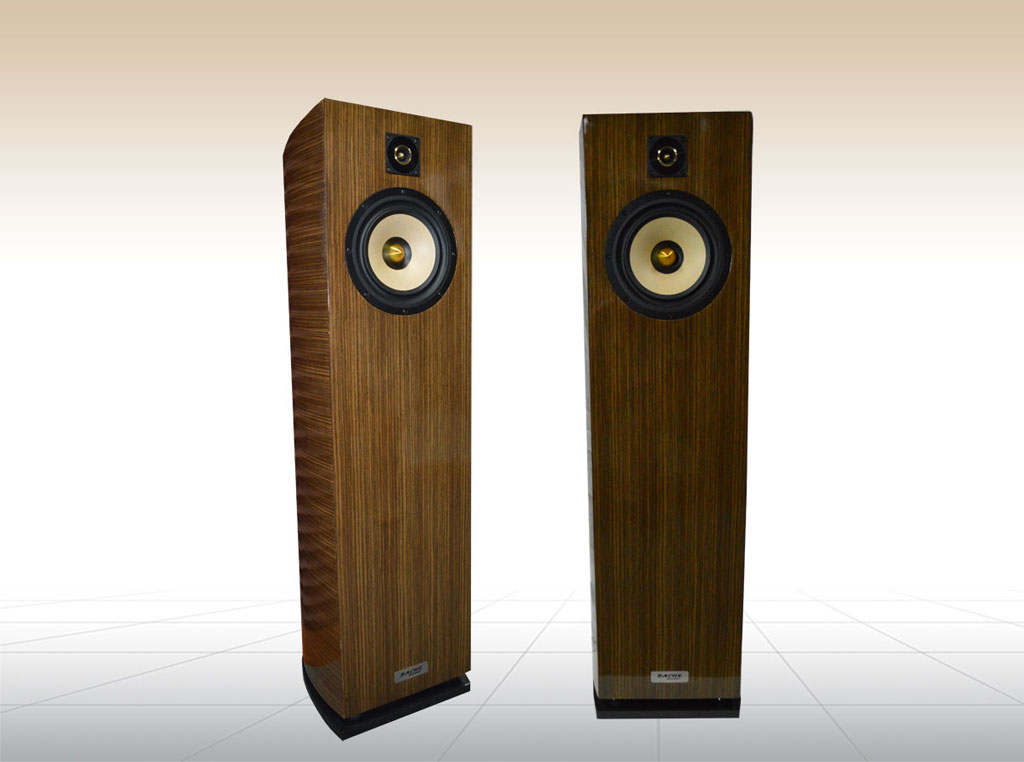 I am a fan of so-called “augmented wide bander” speakers, by which I mean speakers that use a wide band driver for the majority of the audible frequency range, supplemented below with a woofer, and (sometimes) above with a tweeter. Such speakers have the benefits of wide-band drivers (namely, their dynamics and coherence) but without their major drawback (namely, limited frequency extension). An example of such a speaker is the Surreal Sound Fifth Row speaker; which I previously reviewed in these pages (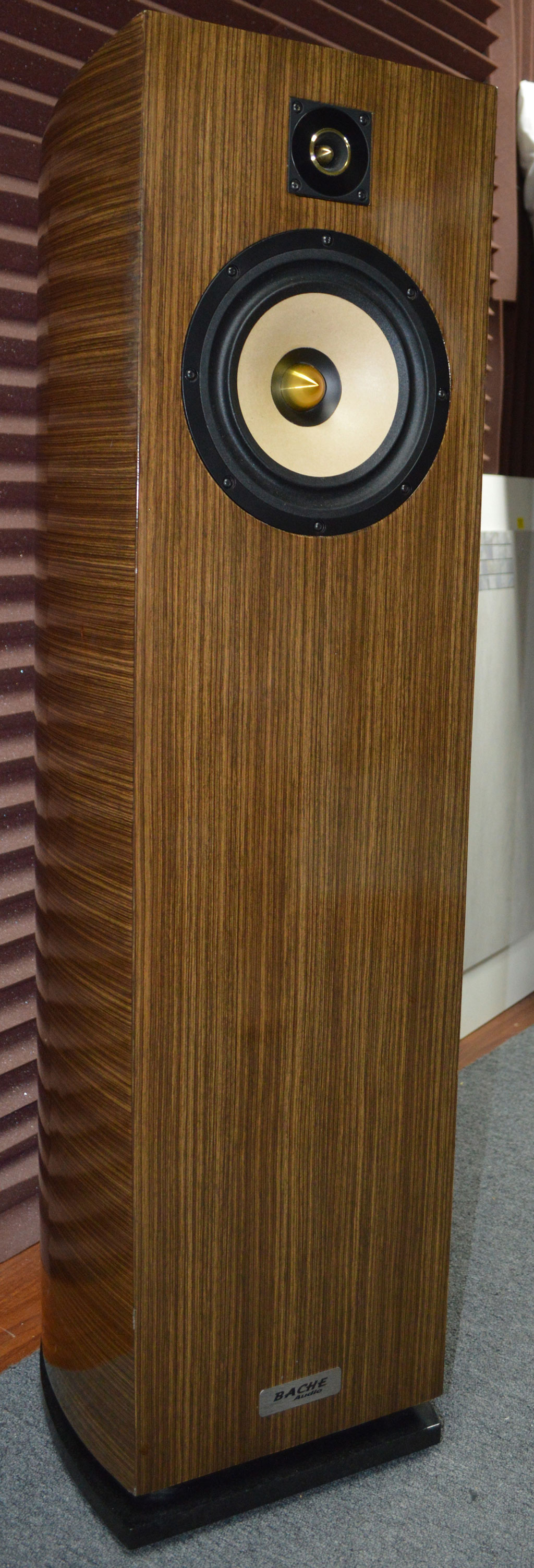
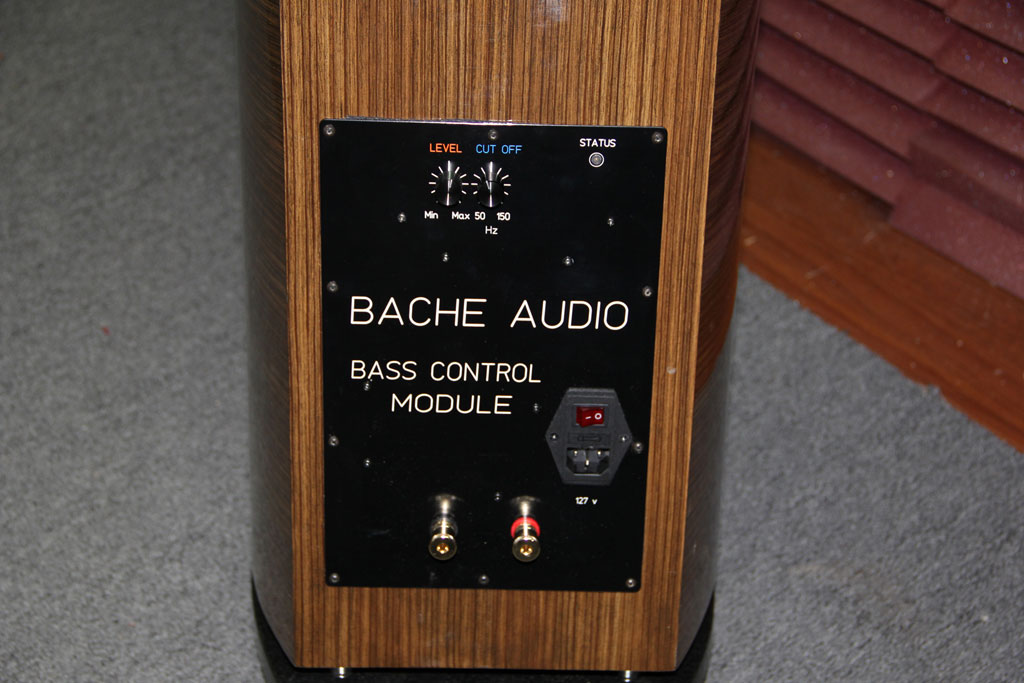 Last but not least, we come to the bass. For a number of reasons, some of which are inter-related, bass presents the greatest problems for a speaker. In no particular order: 1. Bass requires “moving a lot of air,” which places considerable demands on a woofer, including the cone itself, the support mechanism (basket, surround, etc.), and the motor assembly (magnet and voice coil.) 2. Bass response is critically dependent on the cabinet (ignoring for now, open baffle designs). The two most common designs — acoustic suspension (i.e., sealed cabinets) and bass reflex (i.e., ported designs) each has its own strengths and weakness, which translates to compromises. 3. Three desirable traits in a woofer are (a) bass extension, (b) efficiency, and (c) small enclosure. Hoffman’s Iron Law teaches that a design can have two, but not all three. Put another way, a designer picks the two qualities he most favors, but pays for it with the third. 4. Woofers have hefty power requirements, which puts limits on the choice of amplifiers (an issue I will return to in a moment). 5. Room interactions (i.e., nodes and standing waves) play a critical role in bass response, and are far more difficult to control than are high- and mid-reflections.
 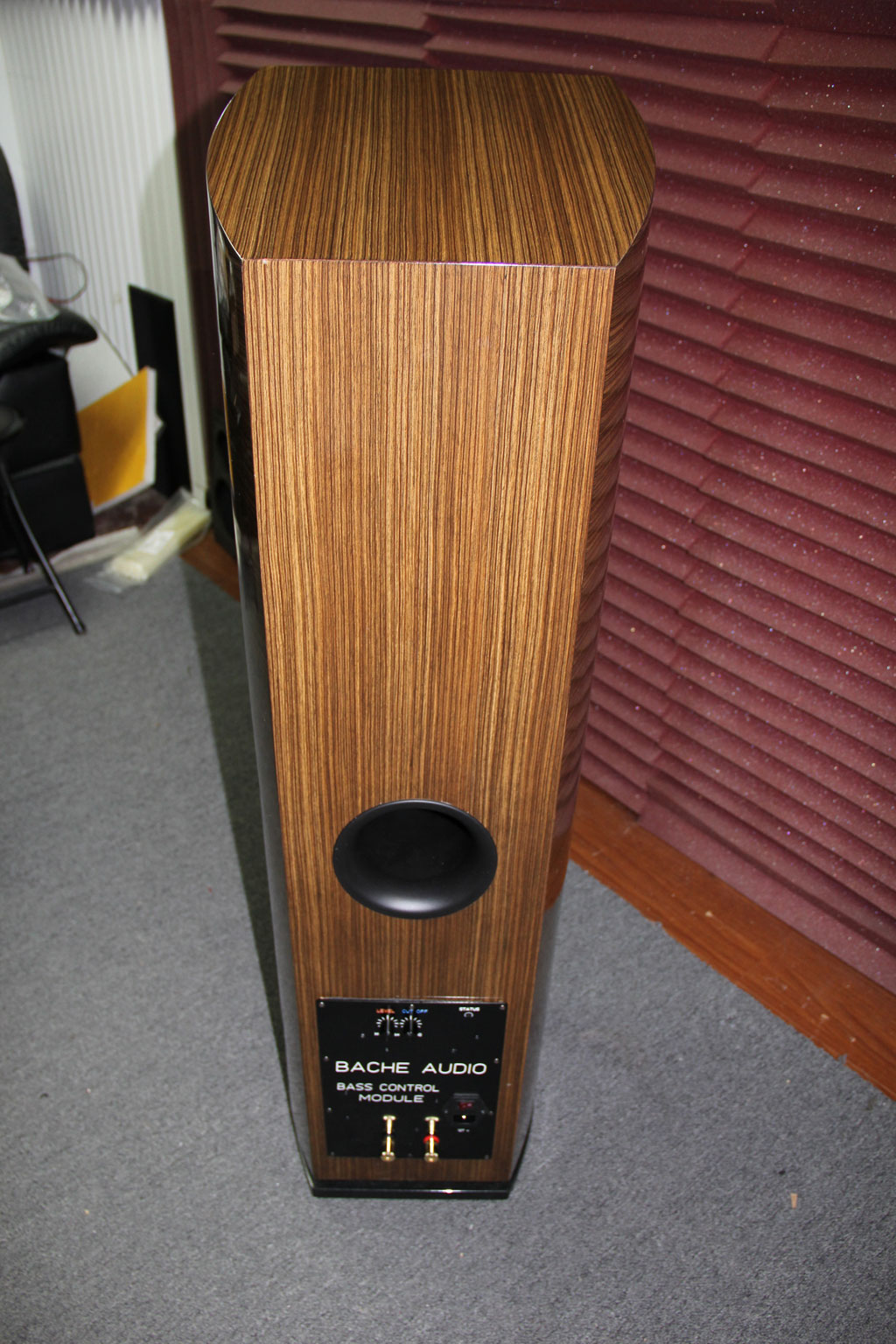 As I have written before in these pages, I am of the belief that every speaker should have an active crossover for the woofer, which would thus have its own amplifier. (The amp can be in the speaker or external.) This arrangement offers a number of advantages. First, by using an active crossover, the amp is connected directly to the woofer. By not having a crossover between the amp and woofer, the woofer benefits from the full damping factor of the amp. (In a typical scenario in which a passive crossover is situated between the amp and the woofer, the amp’s damping factor is severely reduced.) Second, because the woofer places the greatest demands on an amp, having a dedicated amp for the woofer allows one to use a wider variety of amps for the other drivers. Third, bass response varies enormously between rooms. Having a dedicated amp (with adjustments) for the woofer allows one to, at minimum, adjust the bass volume for the room. As noted above, the Bache 001 AB, but not the 001PB, has a dedicated amp for the woofer. Not surprisingly, the two speakers — which are otherwise identical — vary significantly in their bass response, especially with lower-powered amps. When used with the 30 W/channel Soul amps, the woofer of the passive 0001PB was poorly controlled. This manifested as flabby or tubby bass response, with a lot of overhang. In other words, poor transient response. Things improved dramatically when I switched to the Veritas amps, which have enormous power (400 W into 8 Ohms) and equally if not more important, a very high damping factor. With the Veritas the bass was much improved. It was considerably tighter than with the Soul amps, and went deeper. All-in-all, it was improved, but not – as we shall soon see – -as good as it could be. Switching to the active 001 AB was transformative. I began by using the Soul amps powering the Tangband/Fostex array. The Souls are a hybrid design, in which solid state is used in the input section to provide proper voltage and current to the parallel single ended KT88 output tubes. Whereas I find most tube amps to be sluggish and deeply colored, the Souls (which have very wide bandwidth) are fast, and not at all tubey-sounding. They sounded terrific with the 001 AB’s, allowing the speed of the Tangband to manifest, with just a touch of midrange bloom. The bass, powered by the internal; BASH amp, was far more articulate than was the passive 0001 AB. It had a lot of detail (yes, bass should have detail), with relatively good transient response. It went quite deep and had good power, especially given it’s reasonably modest footprint. As a general rule I prefer speakers with front-firing woofers, as these seem to have better “attack.” That said, the Bache’s downward firing woofer, which operates only from 100 Hz and down, performed well in this regard. All in all, the bas was improved in every parameter, as compared to the passive version. I next switched to the Veritas amps. My expectation was that — unlike the situation with the passive 001 PB — this would offer no improvement in the bass. I was wrong! To my amazement, the bass got even tighter, with better transient attack, and less overhang. I don’t know if this is the result of the Veritas’ greater power, greater damping factor, or lower distortion, or some combination thereof. Whatever the reason, the results were significant, though certainly not as great as with the passive version. Of course, the Veritas’s power, speed and low distortion also manifested superbly with the mid and upper frequencies. The Veritas was my amp of choice with the 001 PB, as it has become with a variety of other speakers. As should be apparent, I strongly preferred the active 0001 AB to the passive 001 PB. Conclusions High bandwidth drivers have something of a cult following. Though they have many desirable properties, they also have a number of all-too-obvious deficiencies. Bache Audio has done an admirable job of building an “augmented widebander” speaker with a modest foot print, and a modest (by
Recent Comments