
Future Tech at Capital Audio Fest 2023 | Bacheaudio: 002 speakers
Bacheaudio: 002 speakers
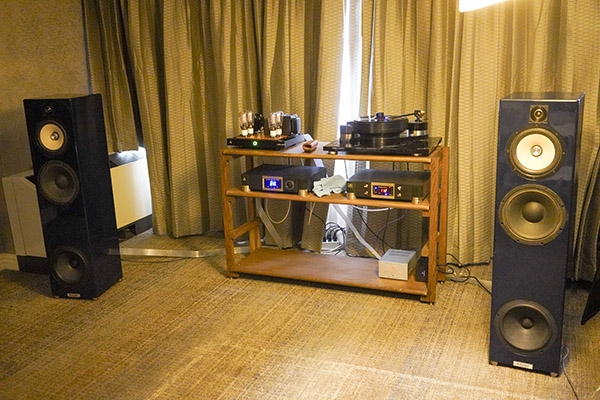
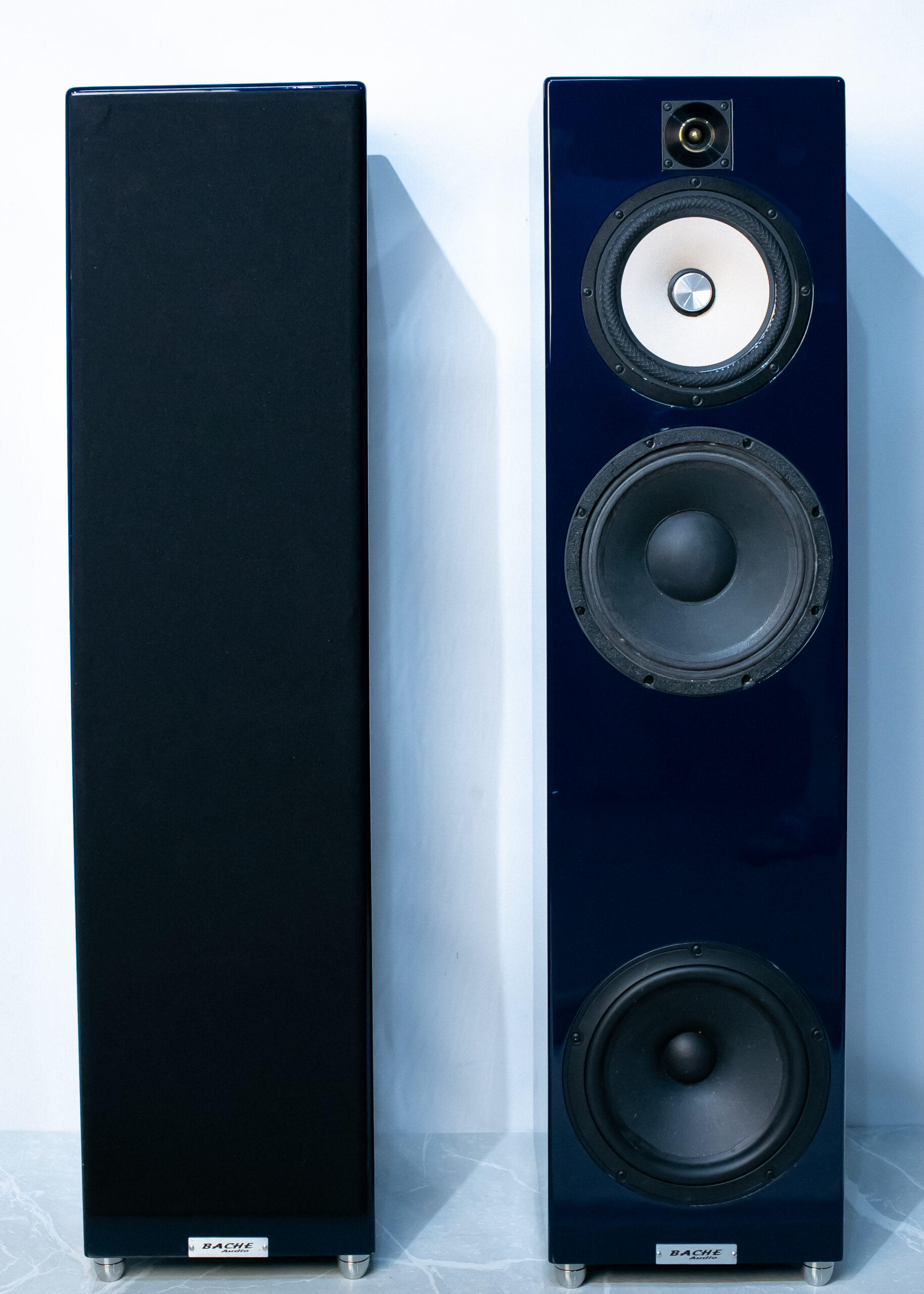
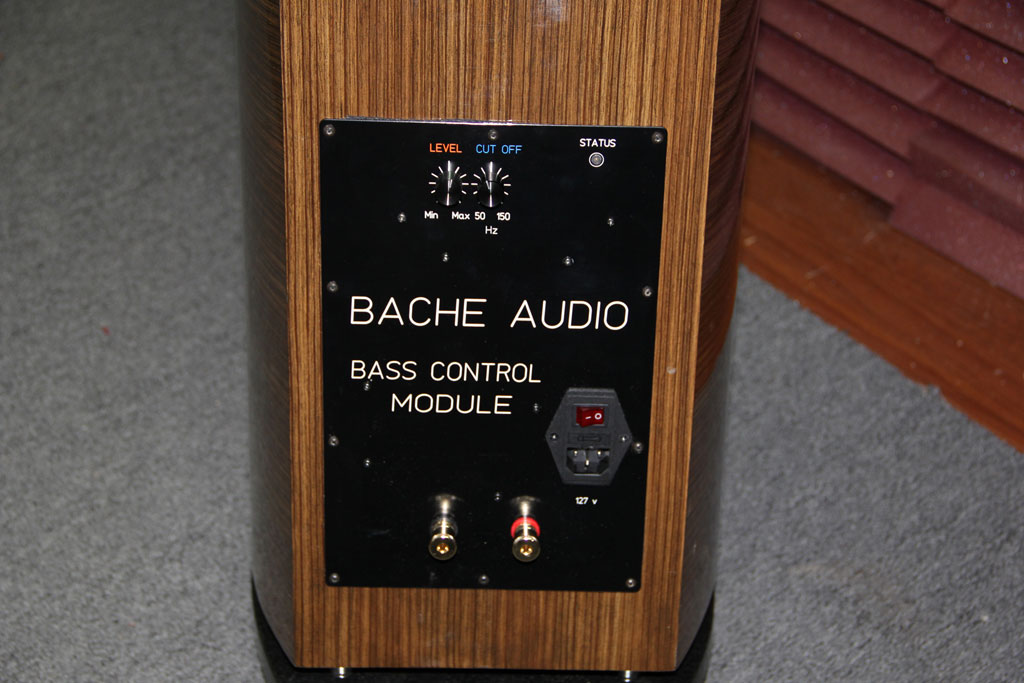
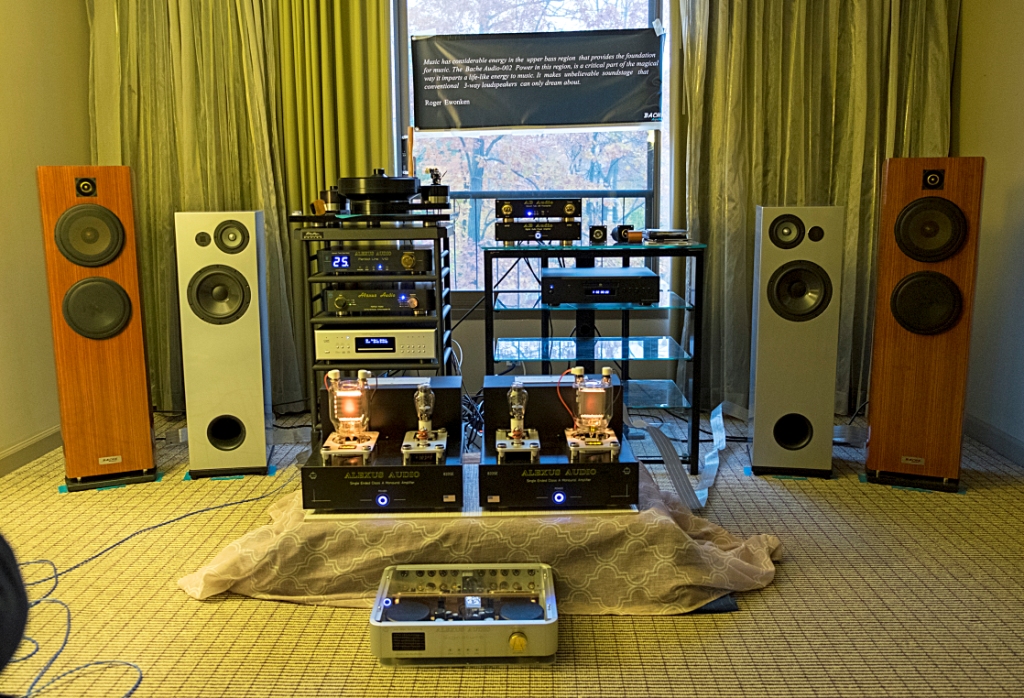
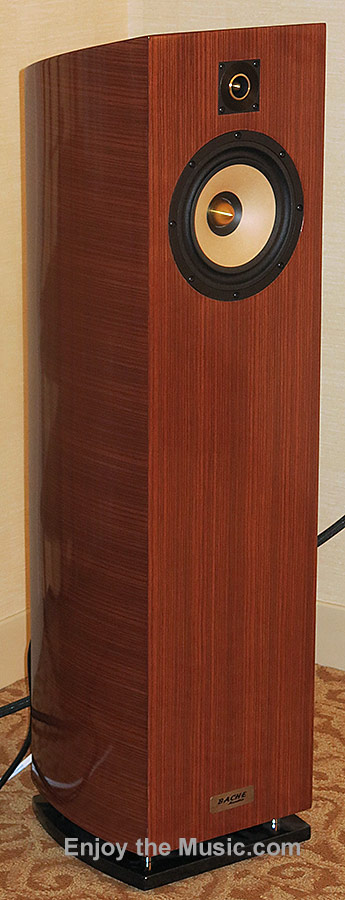
Bacheaudio was demonstrating their 002 loudspeaker. A semi-unconventional design, the 002 features an active 10” woofer with a bass level adjustment. A level control hardly seems like a breakthrough, until you consider the large variations in output below 100 hz experienced in real rooms with real seating positions. It practically defies logic that the low frequency output of a speaker should be held constant in all these cases. But, most speakers and electronics stacks do not allow this adjustment.
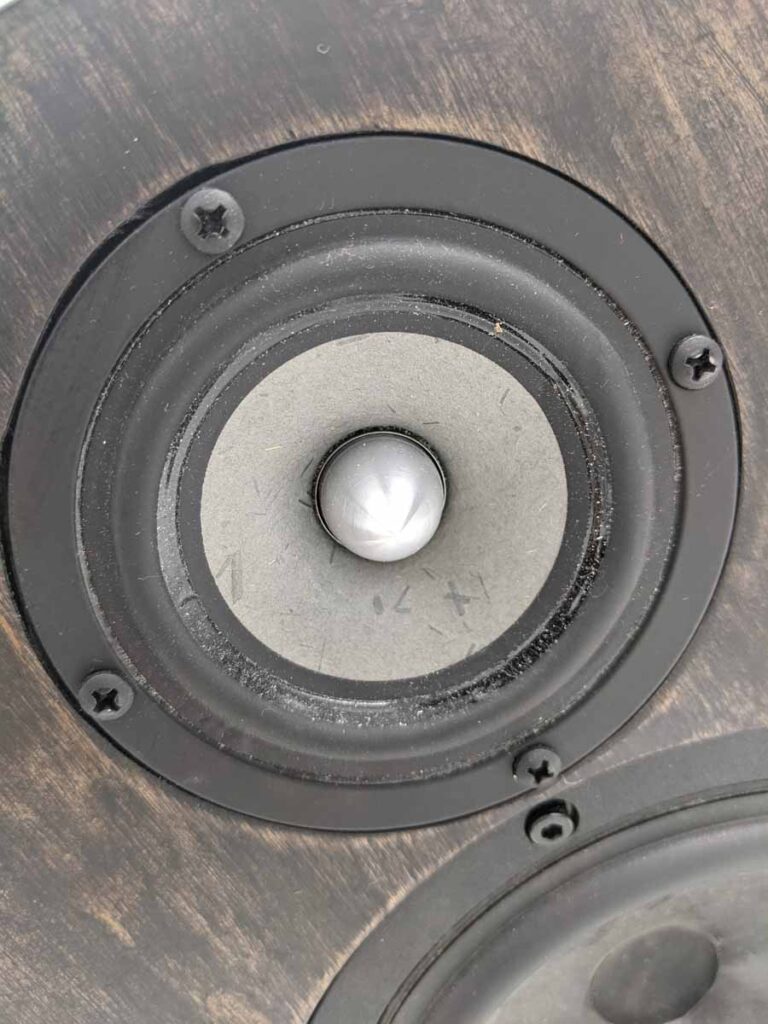
The woofer is crossed over to a 10” paper cone mid-woofer. The main driver is an 8” bamboo fiber midrange/tweeter which is run without any crossover. To support frequencies above 10 kHz, a Fostex super tweeter is used, and this also features a level control.
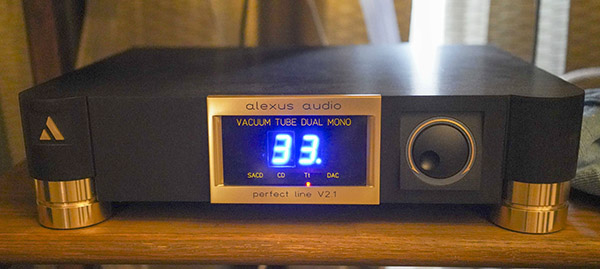
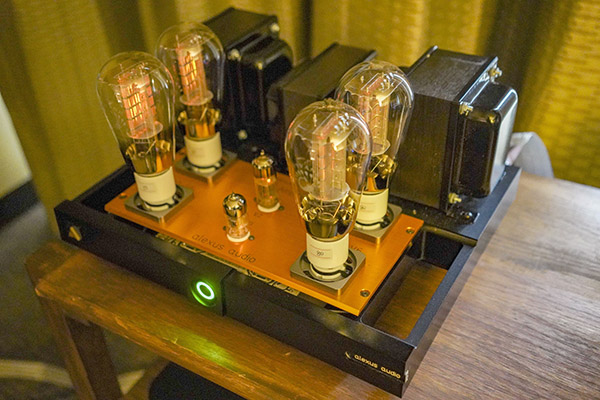
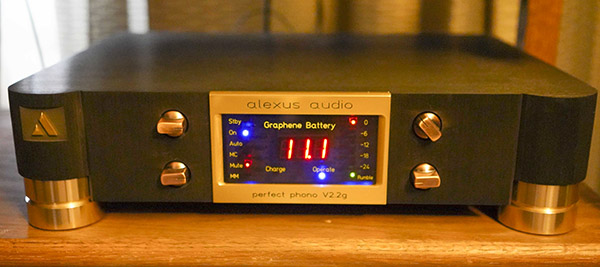
The goal is to create a high efficiency speaker with controlled directivity. Rated at 96db at 1 meter, the efficiency is high enough to allow use of SET or other low-power amplifiers. Bache demoed the 002 with a 15 watt per channel Alexus Audio SET amp.
The sound was nicely dynamic, with good balance and imaging. I was surprised at the smoothness of the response in the sweet spot. This speaker made me wonder about the potential for high sensitivity (as with horns) and controlled directivity (as with horns or dipoles or omnis) to mix dynamics with spatial accuracy. And to fully exploit the dynamic possibilities, it would be interesting to test speakers like these with bigger than SET power.
The Bacheaudio 002s are priced at $22,500 per pair including the bass amplifier and your choice of a variety of solid wood finishes.

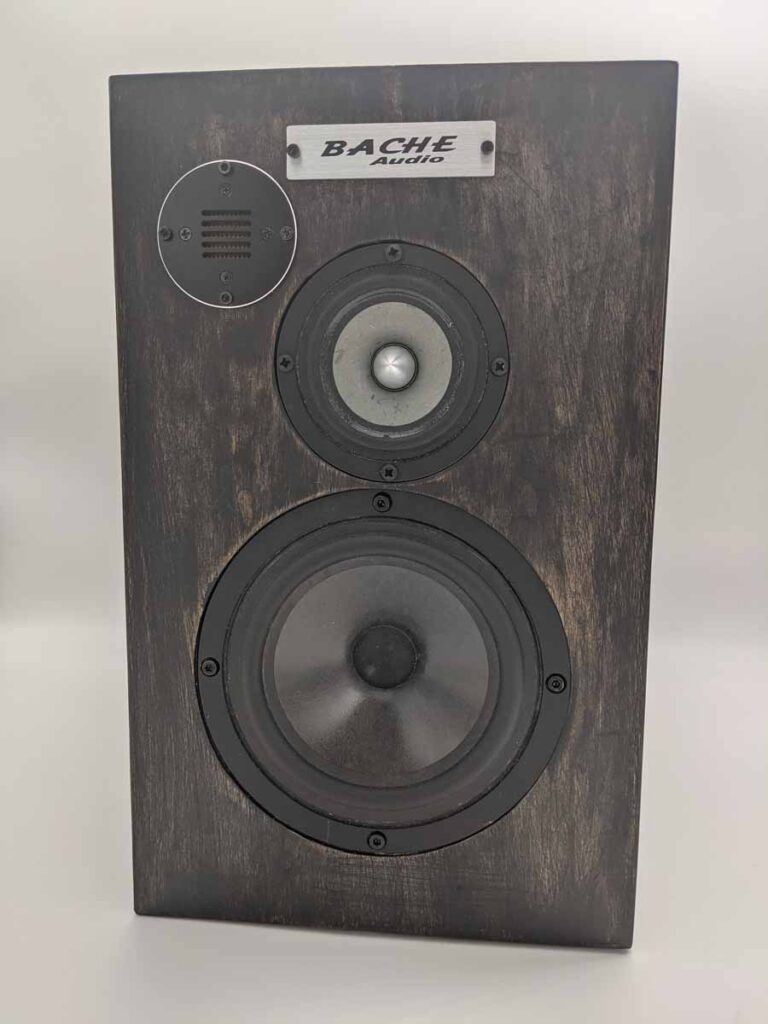 Bache Audio may well be a new name on the audio scene and I for one had never encountered them before until, by chance, I stumbled across them on social media. Bache is based in Brooklyn, New York and originally started creating loudspeakers for their own use but liked what they heard so much they made them available as a commercial product. All their speakers are based around wide-band drivers, which was cause enough to pique my initial interest, and these cover the frequency range from about 100Hz to 10kHz to which Bache say our hearing is most sensitive. These are the only standmounters in the Bache range where you will find four floorstanding models that start at just over $3000.
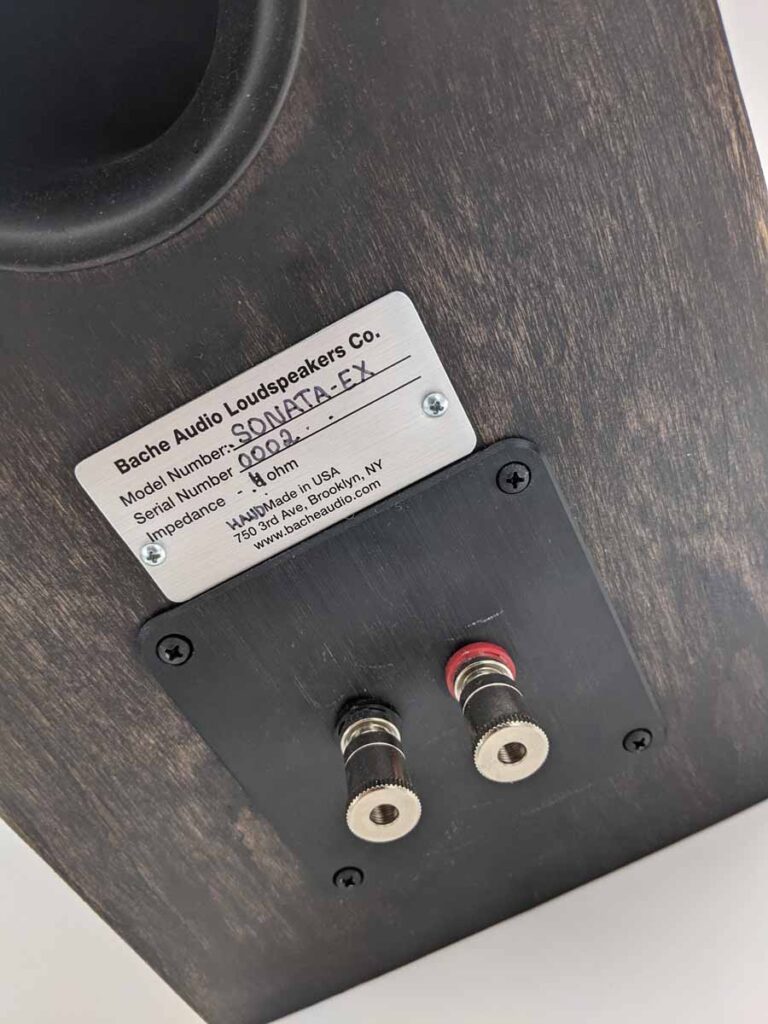
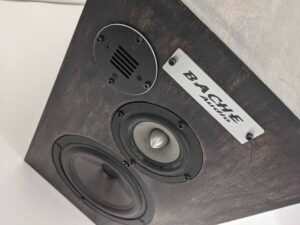
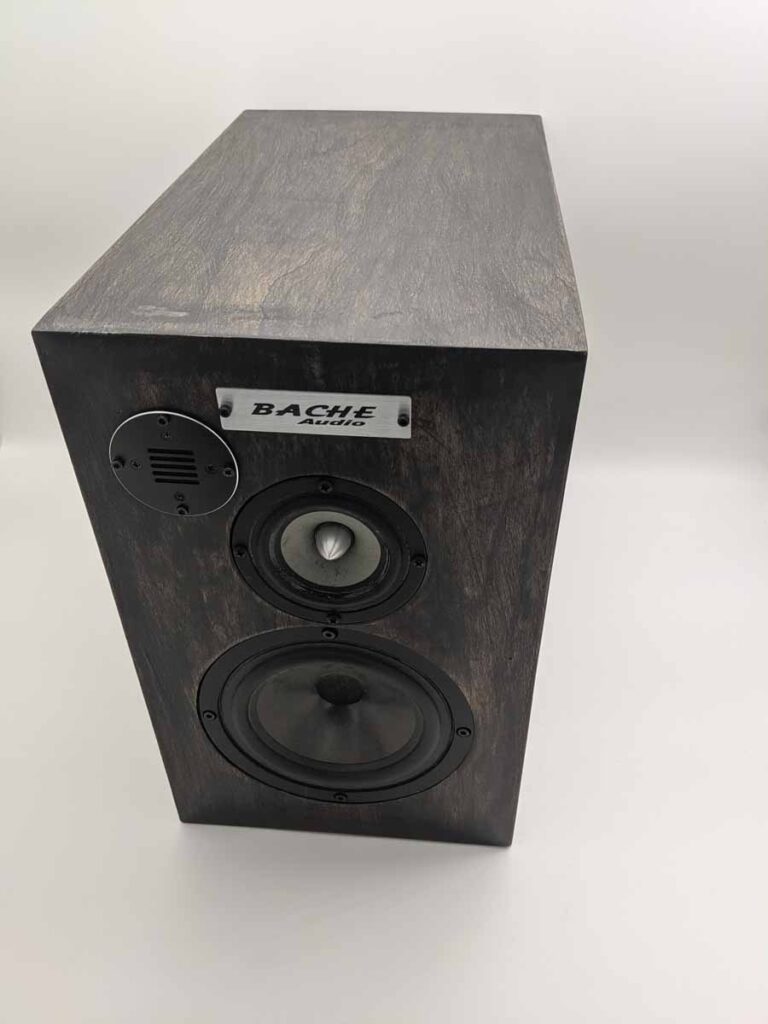 The speakers are made in MDF but you can also get 200mm plywood or bamboo versions for an additional $200. The finish on the pair was a sort of dark brown stain which I actually quite liked, and the speakers are certainly put together very well. Around the back is a single pair of good quality speaker binding posts on a solid metal plate. Looks-wise they are going to divide opinion and they are pretty idiosyncratic in their appearance, though I quite like that difference from the run-of-the-mill. Being hypercritical I think the badge on the front top looks a bit DIY and detracts from the speakers’ look.
 CONCLUSION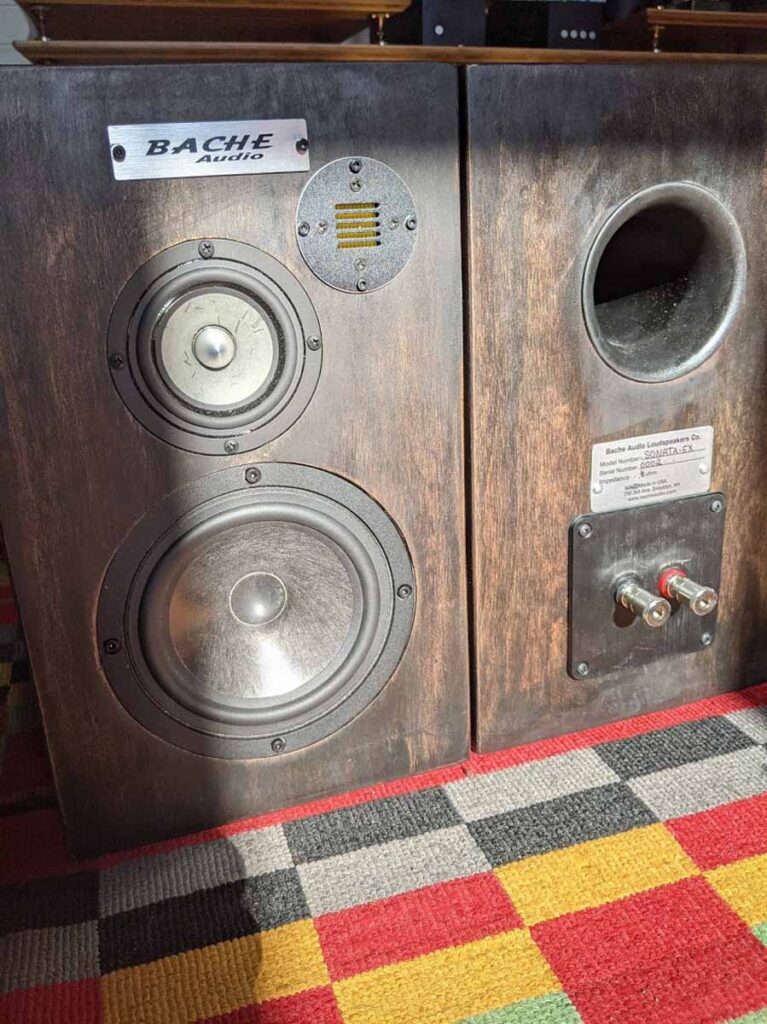
 We Didn’t Love So Much:
 Specifications:






 Read more at
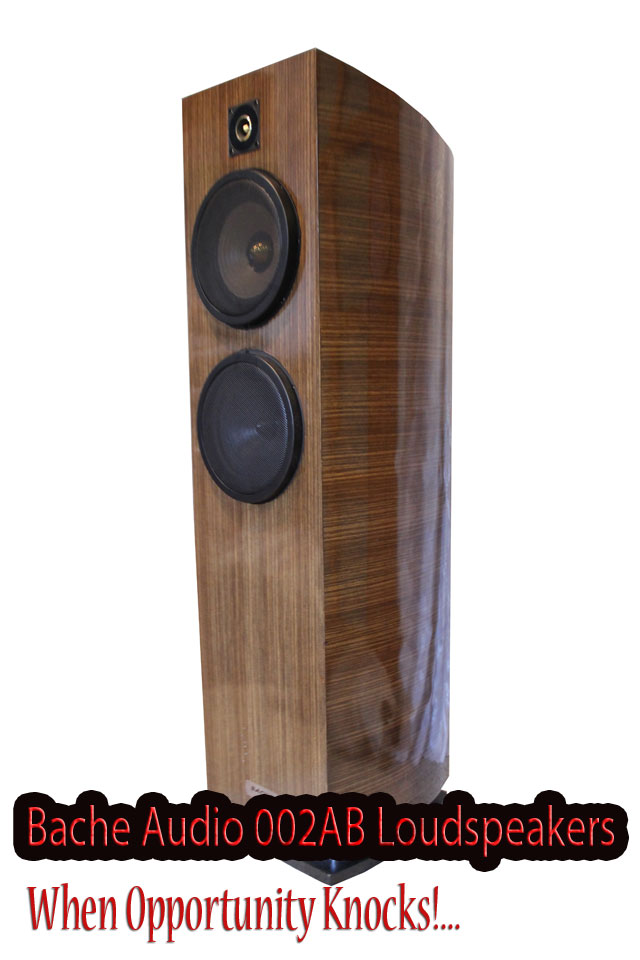
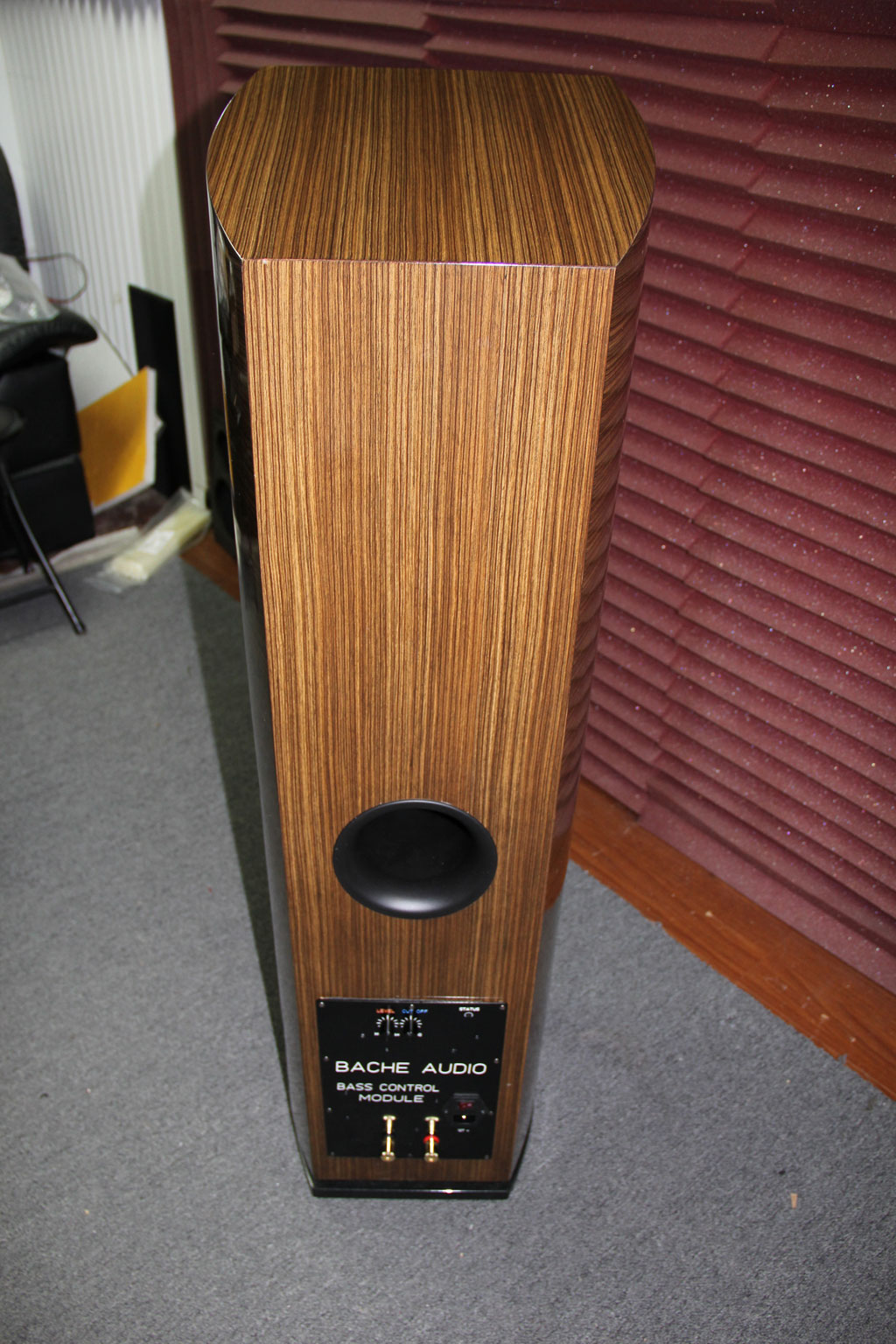
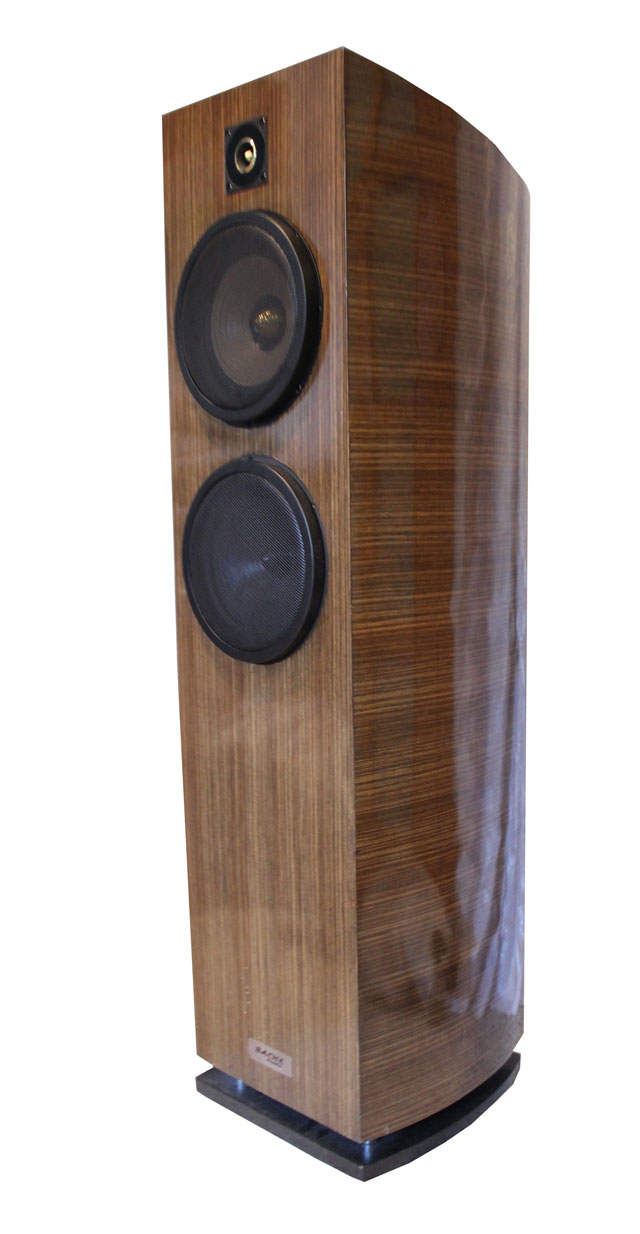 Bache Audio’s 002AB loudspeaker is an efficient full-range, dual ported, four-way design, rated at 96dB sensitive with an impedance of 8 Ohms – so, 8 -100 watt amplifiers are ideal. The 002AB is the update to Bache Audio’s 001AB, which are both based around the increasingly successful widebander driver. The bass drivers are powered by two separate 100 watt amplifiers; one powering the front-facing 10″ woofer and the other powering the 10″ Vifa down-firing lower bass driver. My old reliable 40-watt Opera Consonance M100 SE integrated powered these widebanders and tweeters just fine during most of the review process. Bass volume and crossover settings are adjustable on the 002AB’s rear panel. The tweeter is also adjustable via a 2db boost via jumper pins. The review pair came finished in a handsome high-gloss Zebrawood finish, elevated 2” above a black lacquer base that serve as vents for the 10″ down-firing woofer.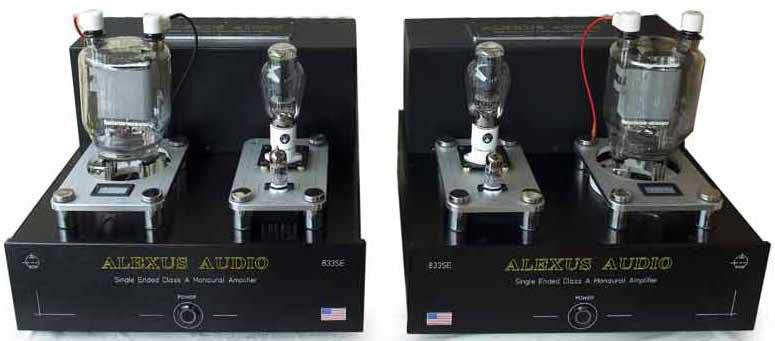
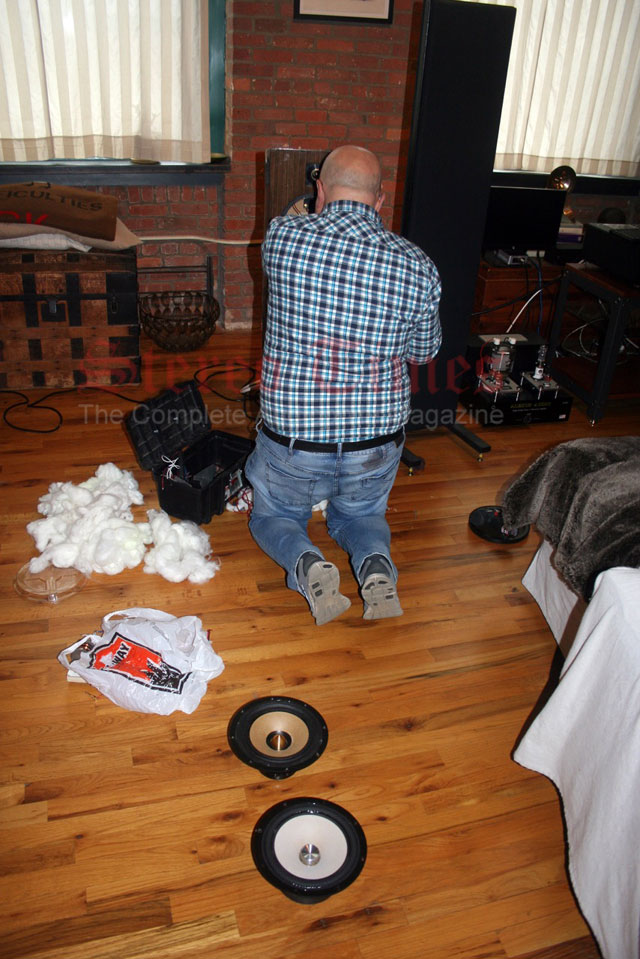
 While the improvements were immediate; improved musicality, dimensional and more dynamic via the insertion of the Alexus Audio 833SEA mono amps, I still was not convinced they were performing on a world-class level. Clement agreed and once again, after about two weeks, relayed this Gregory. Gregory kindly asked if he could return in another week or so. The following weekend, he returned with a brand new widebander midrange-driver – the latest version version using an original bamboo coned driver! Thankfully these had the same mounting schematics, so installation was quick. Gregory had removed the whizzers and updated his crossovers and installed these updates in less than an hour. Clement, Gregory and I, again, listened intently for the results.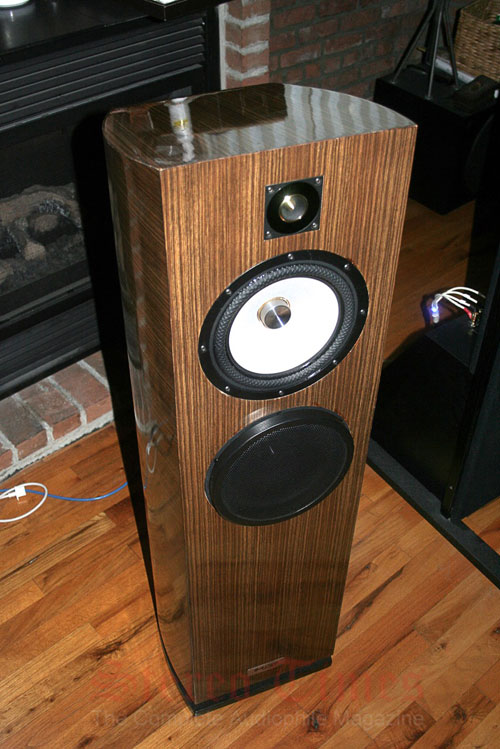
 On John Lurie’s soundtracks for the films “Down By Law & Variety” (Strange and Beautiful 1999), listened as a CD rip here, the bleak spontaneity came through loud and clear over the Bache Audio 002AB’s. Percussive bass and insistent brushwork accompany Lurie’s droning and dominating saxophone lines here, with excellent imaging and soundstage depth throughout this intimately styled recording. The stark “Down By Law” soundtrack has long been a favorite. These newer wideband drivers offers up a flatter response and this creates impressive details to both the mid and lower frequencies. Transients are now more finely etched, bass response feels more dimensional and the soundstage seemed to deepen. Prior to these upgrades, my Eminent Tech’s wanted to go toe to toe with the 002AB’s in overall performance. With Gregory’s improvements, the 002AB’s clearly outperform the LFT-8b’s – especially with respect to focus, transient response and overall musicality.
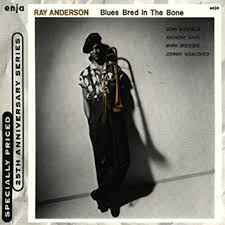 soloing instruments, but Anderson playing sounds effortless and downright slippery on this raucous, joyful and playful on his 1988 release. Anderson continues the bawdiness accompanied beautifully by John Scofield’s guitar work that mirrors his affectations well. Anderson, that loose, percolating, whinny, guttural, bombastic and ever-expressive great horn player was presented beautifully by the 002AB’s.
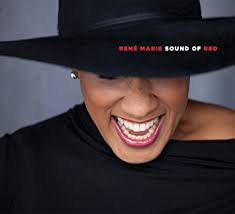 with impressive depth and width to the soundstage. Imaging was precise and the piano’s voice full, persuasive and very nicely rendered. The drums had good depth and dynamics and the bass was full and well-grounded, reaching quite far down. The low end dynamics were impressive and demanding. On “Dodge The Dodo,” I wrote ‘Wow’ in my notes. During play of “From Gaugin’s Point Of View” the 0002AB’s gave strong bass and rendered the effects well, with nice dimension and depth, successfully delivering this added layer of interest to trio interplay.
 On “Remember” from “Gil Evans & Ten” (Prestige 1957), played here from a stereo 24/96 rip of the SACD, there was a wonderful twinkle to the paino keys. The horns were warm and dimensional and there was a delightful depth to the percussion and stage. Sweet horns overlapped one another as they swayed to and fro, an Evans’ trademark. Strong bass and great pacing were captured by the 002AB’s, along with a sweet sax timber and texture and a nice depth to the drums and cymbals. Not bad for 1957.
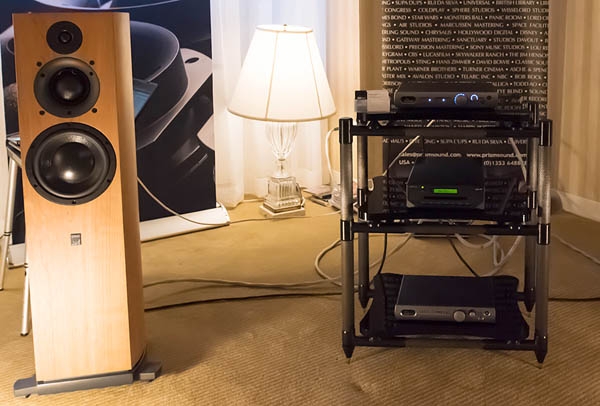 I don’t get out much. In particular, I don’t normally go to audio shows. But this weekend I attended the New York Audio Show, which was held at the Park Lane Hotel, on the south end of Manhattan’s Central Park—just a short subway ride (followed by a shorter walk) from my New York apartment. It was pleasant enough, I suppose, but also a good reminder of the reasons I don’t usually go to audio shows. Reason # 1: There are people there. People who aren’t me. With opinions. Reason # 2: A hotel is a lousy place to demonstrate a fine audio system. Some clichés are true, as was apparent in the first room I walked into, the Prism Sound room, where the company’s $2750 Callia DAC/preamp/headphone amplifier was being demoed with a pair of ATC SCM 40A active monitors, a computer running JRiver, and some cables. The room was small, approximately square, with low ceilings, and—like all the rooms I visited at the show—very yellow. Prism’s Mark Evans told me they’d set up the room three times and torn it apart twice; they ended their work with the speakers firing diagonally across the room, with big bass traps in corners and some sound-absorbing panels at reflection points. The resulting sound was good, not great: rich and full with a soundstage of some depth and adequate width, but a bit fuzzy. The room made it impossible to judge the Callia’s sound, but the company’s history makes the DAC interesting by default. Prism has long been an established leader in the pro-audio world, but the British-made Callia—the name means “beautiful voice” in Greek—is their first consumer DAC. The Callia has all the usual inputs and natively handles PCM up to 192/24; it can play files up to 384/32, but it decimates these higher resolutions down to 192/24, which should not affect sound quality. The Callia handles DSD, too, via its USB input, but it’s a PCM-centric DAC: DSD must first be converted to DoP (DSD-over-PCM) and then is converted to PCM internally. Anyone who feels, as I do, that a pro heritage is a good thing in a source component, should consider adding the Callia to their audition list.
  The problem with hotel rooms, though, isn’t limited to sound. It includes smell. The second room I entered—after Prism Sound—was the Wes Bender Studio NYC room. When I got to the room, Wes was busy dealing with hotel staff, seeking a way to deal with the room’s smells; it seems likely that the toilet had overflowed not too long ago, soaking the carpet. Wes had retrieved a bottle of carpet cleaner and was preparing to soak the carpet. The Wes Bender room had a Danish theme; it featured GamuT everything, with a tiny bit of Ortofon. The lovely stand-mounted speakers were GamuT’s RS3i ($20,990/pair); they were spaced widely along the narrow room’s long wall. Electronics were the GamuT D3i dual-mono line-level preamp ($8380), the D200i dual-mono stereo preamplifier ($13,990), and a CD3 CD player ($7990). Cabling was from GamuT’s Reference series. The Ortofon touch was a step-up transformer sitting on the big (42″) Stillpoints ESS rack ($10,700). The analog source was the lovely Slovenian-built—and Stereophile A-rated—Pear Audio Blue Kid Thomas Turntable ($7995 with their Cornet 2 tonearm), assisted by the company’s Blue Classic phono stage ($1995) and external power supply ($2000). The cartridge was a Transfiguration Proteus. These widely spaced, smallish, stand-mounted speakers presented a big stage, whether it was the Kiki Dee band on CD (an inspired choice for an audio show—definitely not the same ol’ same ol’) to McCoy Tyner’s New York Reunion LP on Chesky Records. Images were, as you would expect with this speaker geometry, big and broad if perhaps not as solid as they would be with speakers closer together, but this is a good example of working with the room instead of fighting it. Reason #3: The music. While I was in the Prism Sound room, music by pianist/composer Hiromi was playing. Hiromi’s okay, but there are better things to listen to—like, say, classic jazz on a well-kept old LP (or a good CD for that matter), or maybe something new and good. Two of the next three rooms played Diana Krall. In one room, an attendee interrupted some decent tunes to put on his favorite 1812 Overture CD—who listens to this stuff? Pop orchestral favorites such as Manuel de Falla’s The Three-Cornered Hat (with the annoying piccolo) and Rachmaninoff’s Symphonic Dances were abundant—but where were the concertos and the chamber music? It’s no one’s fault, really. It’s not, I’m thinking, that anyone really loves this music—although perhaps I overestimate audiophiles. It’s like politics: Everyone has their own ideas, so you end up with the lowest common denominator, music no one especially likes but no one despises. The Replacements would probably offend 2/3 of the people in the room, Bad Brains 90%. Still, some choices are hard to fathom: Why isn’t there more classic jazz? Why no late-period Duke Ellington or Count Basie? Aren’t some of those recordings are show-worthy? It’s all the more reason to stay at home and listen to whatever I want to. I don’t ask for much. If I’d even heard, say, some Pink Floyd or a nice Grateful Dead live groove, I might have put down a sleeping bag and stayed the night—which, come to think of it, might be another reason not to play good music at audio shows.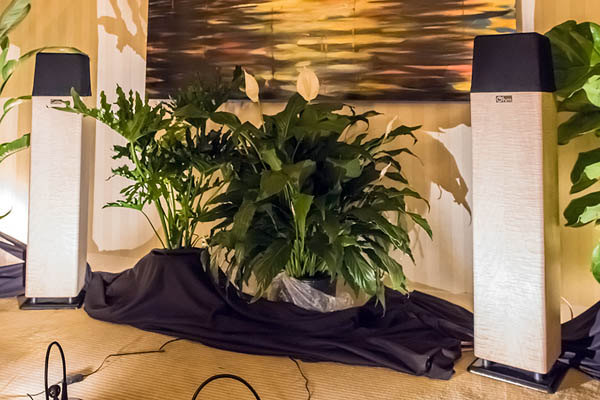
 My experience in the Ohm room led to an insight: ambience is overrated. It’s also one of the hardest things to get right. I think what happens is this: ambience captured on recordings gets mixed up with the ambience of the listening space, causing spatial-aural confusion. It’s a conspiracy of room, speaker, and recording, each contributing something to the chaos. I find myself trying, as I did in the Ohm room, to listen through, not to, the ambience. Better to have slightly rolled-off highs, in my view, than to have more extended highs. Ambience becomes noise in much the same way that a flower growing in the wrong place is a weed. This was not a problem in the room presented by New Jersey-based dealer The Art of Sound because of the imposing Sonus Faber Amati Futura loudspeakers. This was another long, narrow room with equipment set up along the long wall. This room didn’t have that high-end problem—which made sense after I read
 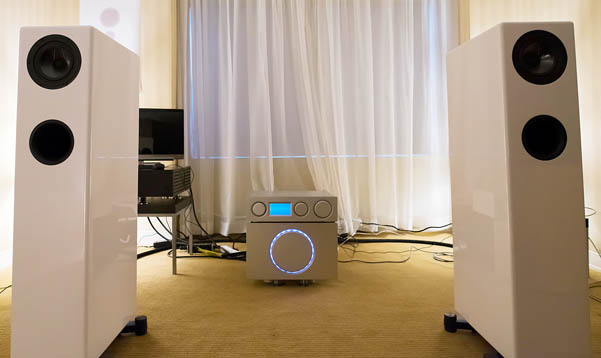 The room hosted by Connecticut-based Laufer Teknik featured the big, perfect-looking Ascendo D9 loudspeakers ($13,750/pair) and electronics—as pretty as the speakers and a great visual match—from Behold: the BPA 768 stereo amplifier and the APU 768 stereo preamp with built-in DAC (prices not specified). In this small room, the big D9s were set up so close together that I doubt you could have laid another B9 on its side in between them, probably to keep them away from the side walls. I’m sure these big boys are capable of bigger sound, but in this modest setup the sound was very good. When I saw a picture on the NY Audio Show website of Laufer Teknik’s Memory Player Mini ($2495), I assumed there was a mistake: The picture was of an NUC, a tiny Intel-based computer that you can buy at most electronics stores. I have one at home. My NUC, which I use as an audio server, running Roon, sounds just fine. But if Laufer’s enhancements improve the sound substantially, it could be well worth the price. It was impossible to tell under show conditions whether it does or doesn’t, but I’m hoping to try out these enhancements on my own NUC.
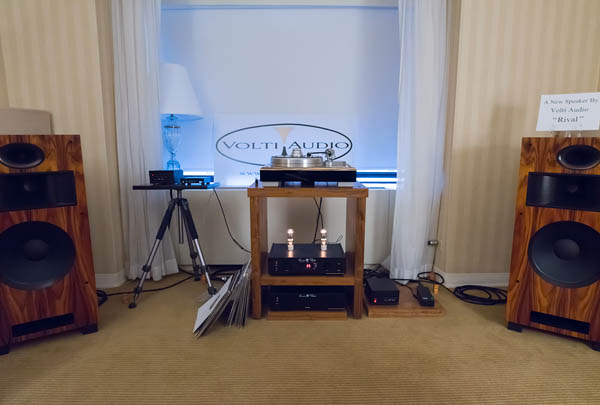 My award for Most Surprising Sound goes to the Vinnie Rossi/Fidelis AV room, where the smaller (but still imposing) Volti Audio horn loudspeakers—the Rivals—belied their big (41.5″ x 19″ x 16″), aggressive-looking boxes and modest price (starting at $7900/pair) with surprisingly intimate sound, via amplification from Vinnie Rossi: the VR120 Stereo Power Amplifier ($4995) and the modular LIO Integrated amplifier, with direct-heated triode line stage, DAC, and phono-stage options ($10,280 as configured). Ricky Lee sang from the Show Biz Kids LP via an Acoustic Signature Triple X turntable with a TA-2000 tonearm and the Dynavector XX2 Mk.II cartridge ($5795, $2399, and $1995 respectively). The big bass excited some room (and possibly speaker) resonances, but overall it had good texture. Read more at http://www.stereophile.com/content/nyas-2016-day-one-jim-austin#z991IouMgPT8PWAZ.99
 I am a fan of so-called “augmented wide bander” speakers, by which I mean speakers that use a wide band driver for the majority of the audible frequency range, supplemented below with a woofer, and (sometimes) above with a tweeter. Such speakers have the benefits of wide-band drivers (namely, their dynamics and coherence) but without their major drawback (namely, limited frequency extension). An example of such a speaker is the Surreal Sound Fifth Row speaker; which I previously reviewed in these pages (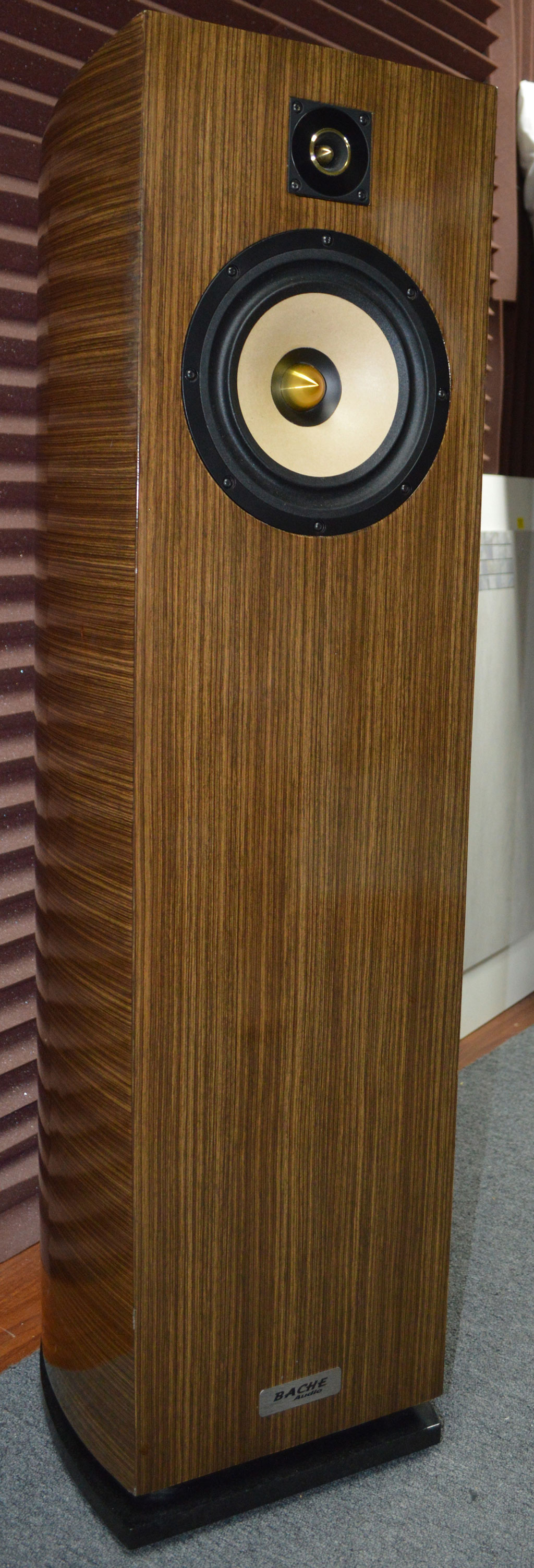
 Last but not least, we come to the bass. For a number of reasons, some of which are inter-related, bass presents the greatest problems for a speaker. In no particular order: 1. Bass requires “moving a lot of air,” which places considerable demands on a woofer, including the cone itself, the support mechanism (basket, surround, etc.), and the motor assembly (magnet and voice coil.) 2. Bass response is critically dependent on the cabinet (ignoring for now, open baffle designs). The two most common designs — acoustic suspension (i.e., sealed cabinets) and bass reflex (i.e., ported designs) each has its own strengths and weakness, which translates to compromises. 3. Three desirable traits in a woofer are (a) bass extension, (b) efficiency, and (c) small enclosure. Hoffman’s Iron Law teaches that a design can have two, but not all three. Put another way, a designer picks the two qualities he most favors, but pays for it with the third. 4. Woofers have hefty power requirements, which puts limits on the choice of amplifiers (an issue I will return to in a moment). 5. Room interactions (i.e., nodes and standing waves) play a critical role in bass response, and are far more difficult to control than are high- and mid-reflections.
  As I have written before in these pages, I am of the belief that every speaker should have an active crossover for the woofer, which would thus have its own amplifier. (The amp can be in the speaker or external.) This arrangement offers a number of advantages. First, by using an active crossover, the amp is connected directly to the woofer. By not having a crossover between the amp and woofer, the woofer benefits from the full damping factor of the amp. (In a typical scenario in which a passive crossover is situated between the amp and the woofer, the amp’s damping factor is severely reduced.) Second, because the woofer places the greatest demands on an amp, having a dedicated amp for the woofer allows one to use a wider variety of amps for the other drivers. Third, bass response varies enormously between rooms. Having a dedicated amp (with adjustments) for the woofer allows one to, at minimum, adjust the bass volume for the room. As noted above, the Bache 001 AB, but not the 001PB, has a dedicated amp for the woofer. Not surprisingly, the two speakers — which are otherwise identical — vary significantly in their bass response, especially with lower-powered amps. When used with the 30 W/channel Soul amps, the woofer of the passive 0001PB was poorly controlled. This manifested as flabby or tubby bass response, with a lot of overhang. In other words, poor transient response. Things improved dramatically when I switched to the Veritas amps, which have enormous power (400 W into 8 Ohms) and equally if not more important, a very high damping factor. With the Veritas the bass was much improved. It was considerably tighter than with the Soul amps, and went deeper. All-in-all, it was improved, but not – as we shall soon see – -as good as it could be. Switching to the active 001 AB was transformative. I began by using the Soul amps powering the Tangband/Fostex array. The Souls are a hybrid design, in which solid state is used in the input section to provide proper voltage and current to the parallel single ended KT88 output tubes. Whereas I find most tube amps to be sluggish and deeply colored, the Souls (which have very wide bandwidth) are fast, and not at all tubey-sounding. They sounded terrific with the 001 AB’s, allowing the speed of the Tangband to manifest, with just a touch of midrange bloom. The bass, powered by the internal; BASH amp, was far more articulate than was the passive 0001 AB. It had a lot of detail (yes, bass should have detail), with relatively good transient response. It went quite deep and had good power, especially given it’s reasonably modest footprint. As a general rule I prefer speakers with front-firing woofers, as these seem to have better “attack.” That said, the Bache’s downward firing woofer, which operates only from 100 Hz and down, performed well in this regard. All in all, the bas was improved in every parameter, as compared to the passive version. I next switched to the Veritas amps. My expectation was that — unlike the situation with the passive 001 PB — this would offer no improvement in the bass. I was wrong! To my amazement, the bass got even tighter, with better transient attack, and less overhang. I don’t know if this is the result of the Veritas’ greater power, greater damping factor, or lower distortion, or some combination thereof. Whatever the reason, the results were significant, though certainly not as great as with the passive version. Of course, the Veritas’s power, speed and low distortion also manifested superbly with the mid and upper frequencies. The Veritas was my amp of choice with the 001 PB, as it has become with a variety of other speakers. As should be apparent, I strongly preferred the active 0001 AB to the passive 001 PB. Conclusions High bandwidth drivers have something of a cult following. Though they have many desirable properties, they also have a number of all-too-obvious deficiencies. Bache Audio has done an admirable job of building an “augmented widebander” speaker with a modest foot print, and a modest (by
 speakers revolves around using a full-range single-driver design. Owners of these types of speakers experience the beautiful sonic virtues of total transparency, allowing every little detail of the music to be heard, as well as the natural rendering of tones and timbres, the purity and speed often found only in horn-loaded designs, and a seamlessness to the music because there is no crossover. All the frequencies of the music are presented in a perfect tapestry mimicking the sound of live music. People who use SET amplifiers are also enamored with single-driver designs because these speakers often have 90-dB or higher sensitivity with no wicked impedance curves and can be driven to very high volume levels by less than 10 watts.
 The New York Audio Show 2015 introduced me to today’s Bache Audio 002AB speakers. Two Brooklyn audio designers originally from Russia shared a room to show their speakers and electronics to the public for the first time. Greg Belman designs the Bache Audio speakers, Alex Chorine the Alexus Audio electronics. Several of their speaker models as well as some preamps and solid-state amps were either in use or on display. When I entered, Greg’s 002AB were being driven by Alex’s 833 SET amps. This was the top of the line in their room and I came away impressed by the gutsy full-bodied sound. It was an auspicious demo.
  What also drew my interest was that the 002AB, like the Bastanis Mandala speakers I’d just
 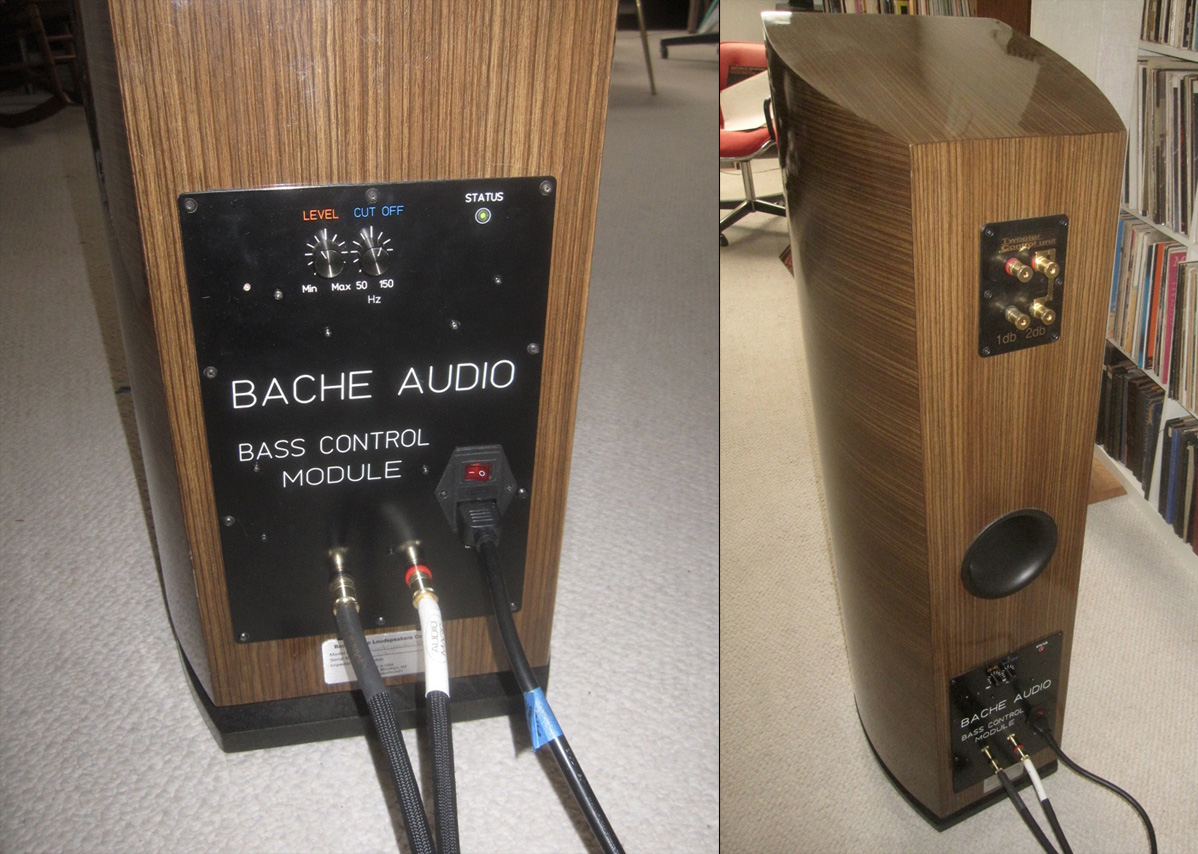 The speaker finish was their standard Zebrawood high gloss. It was attractive but not quite up to the quality of most
 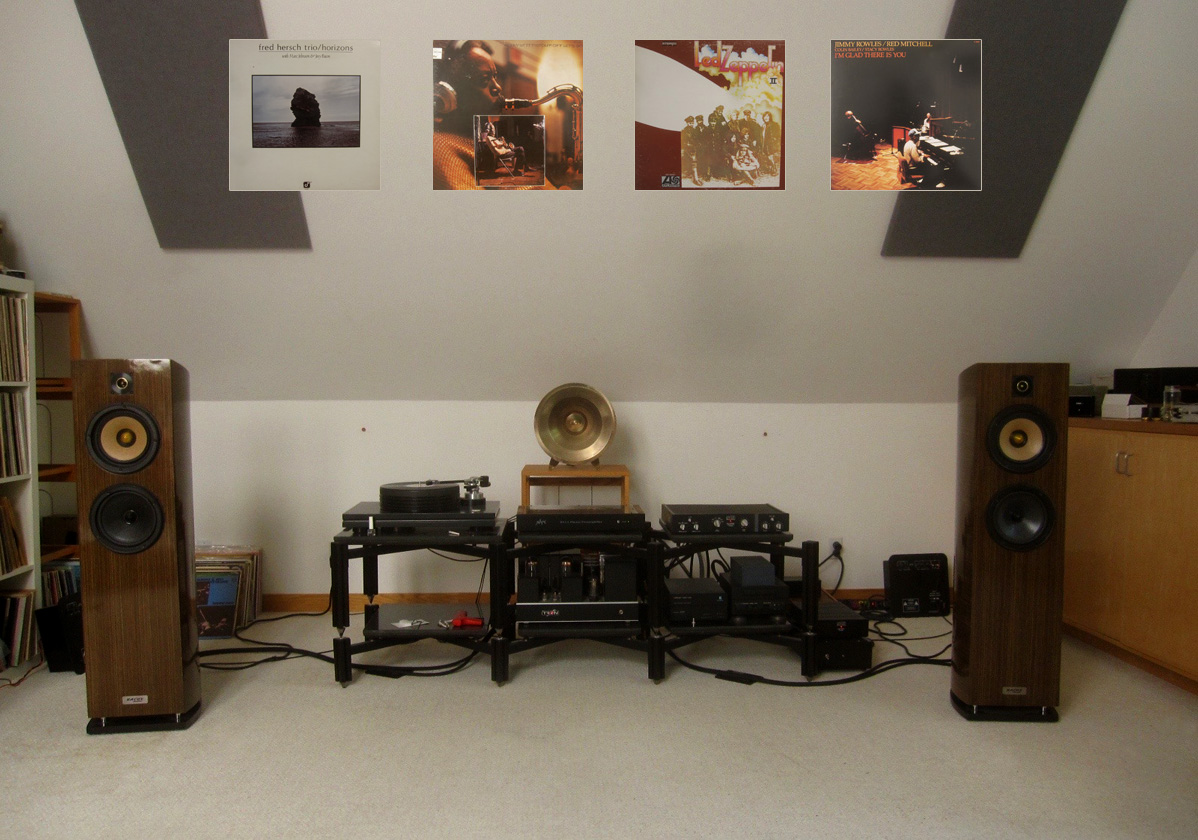 Thinking that perhaps more tweeter output might be a good thing, I moved the jumper from the -2dB to the -1dB attenuation setting. The difference was subtle as one might expect. In the end I preferred the -2dB setting. The tweeter almost never called attention to itself and blended beautifully with the widebander. It was very well behaved but for that had less dynamic impact and detail than the Bastanis Gemini horn tweeter. I did have to make some adjustments to my listening when changing over from the open baffles to the more conventional ported boxes. Some of the ‘live’ quality, rear stage illumination and openness of the Bastanis was not to be had. That is not to say the Bache speakers were lacking or closed in. Comparing them to an open baffle speaker simply was a bit unfair in this regard so I will just say that they staged very well for a box speaker. Depth was portrayed sufficiently but the sound did not project to the outsides of the speakers nor bloomed out in front of them as much as it does with the Bastanis. The Bache Audio 002AB definitely excelled in the critical midbass. The lower range of the piano as well as upright bass were rendered about as well as any speaker I have heard. A striking demo of this was Sonny Stitt’s Stomp Off Let’s Go [Flying Dutchman BDL1-1538] with “Duke’s Place”. Richard Davis’ electric bass strutted up and down the scale with propulsive drive and serious toe-tapping energy. Record producer Bob Thiele deserves credit too for capturing this so well. The built-in powered 10-inch Vifa sub did all I could ask from a subwoofer. While it might not have energized the room like a 15″ or 18″ monster would, I was pleasantly surprised by its power and speed. It never lagged behind and provided a really solid foundation that blended seamlessly. Perhaps my best illustration of this came later in the review process when I decided to see how the speakers fared on some golden oldie Rock from my college days. Going straight for the hard stuff, I dug out my Led Zeppelin II [Atlantic SD 19127], supposedly not the best pressing so I prepared myself for the worst. It was anything but! Wow, the raw power of this legendary album was on full display with a quality I had never heard before. These were great speakers for rock music. The woofer and subwoofer filled out the bottom like nobody’s business: deep, clean, punchy and fast! The Bache spec lists them at 22Hz. While there wasn’t programme that low, I can tell you that listening to Led Zeppelin with the full bottom octaves was like finally hearing the band how they were intended to be heard. It was an entirely new and intense experience. Later that evening, I had my girlfriend come up and listen to the Led Zep II to have us both do our best Wayne’s World of bopping heads totally rocking out. I played it again for a number of other visitors and everyone was mightily impressed.
 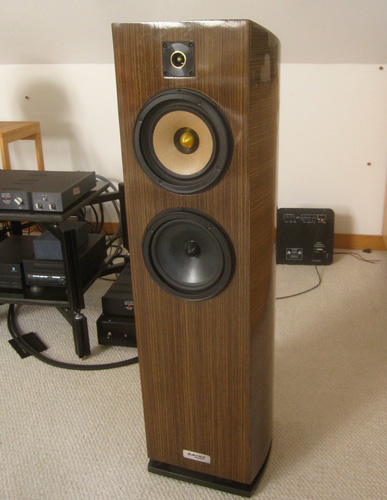 Much of this review was penned with the sound of the Bastanis Mandala fresh in mind. Their design approach is similar in a number of ways and they are natural competitors for lovers of low-power amps. All in all I find both excellent. They each have their strengths. The Bache Audio have an almost unimpeachable tonal balance. As a result I found them to be good for long-term listening with low or no fatigue. They had a smooth quality that on some recordings could almost verge on chocolaty rich. To borrow the late Harry Pearson’s creative descriptive terminology, the Bastanis were the yang (sunlit to bright) to the Bache’s ying (tending toward the dark). Whilst the Tang Band was very smooth and coherent, it was not as revealing as the Bastanis counterpart. It just didn’t have the lightning-fast transients nor reveal the same microscopic level of information and microdynamic shadings. That was not really surprising since the Bastanis driver is exceptional in this regard. With the Mandalas, the most minute variations of a performer’s pressure on the mouthpiece or fret board are laid bare. With the Bache speakers, some of this information was missing. Alas, speed and über resolution aren’t everything. There are tradeoffs. The Bache 002AB speakers were more forgiving and never aggressive. With their hyper-revealing widebander, the Bastanis can occasionally squawk or sound too forward on lesser recordings. Then a bright recording will be practically unlistenable while the Bache speakers made it sound still tolerable. The Bastanis also offer a generally higher excitement level. This also applies at lower levels where the Bache speakers had to be played at a higher volume to open up and properly energize the room. Again, an open baffle speaker has an inherent advantage there in my opinion. To conclude, the Bache Audio 002AB speakers are high-efficiency truly full-bandwidth speakers that will provide great enjoyment with all kinds of music while allowing the majority of the spectrum to be amplified by your favourite low-powered transistor, SET or push-pull tube amp of 8wpc or more. That is quite the accomplishment! When considering the $14’900 asking price, remember that it includes dedicated high-quality woofer and subwoofer amps. In contrast to the Bastanis Mandalas, these speakers were neither finicky about setup nor their associated equipment and seemed almost impossible to make sound bad. When they are gone, I will miss their intrinsic musicality combined with their well-integrated drivers and impressive bass performance. Highly recommended!
 Terry London –






 Show Coverage By Rick Becker, www.enjoythemusic.com
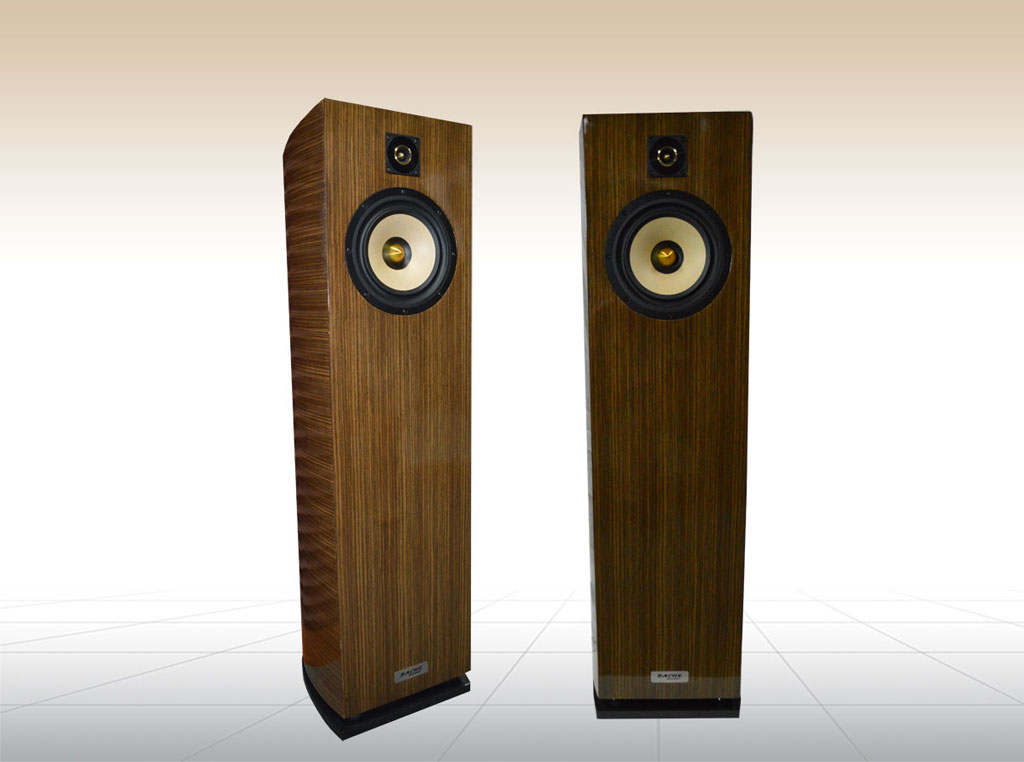
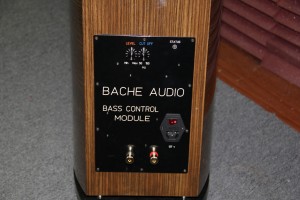
 I am a fan of so-called “augmented wide bander” speakers, by which I mean speakers that use a wide band driver for the majority of the audible frequency range, supplemented below with a woofer, and (sometimes) above with a tweeter. Such speakers have the benefits of wide-band drivers (namely, their dynamics and coherence) but without their major drawback (namely, limited frequency extension). An example of such a speaker is the Surreal Sound Fifth Row speaker; which I previously reviewed in these pages (http://dagogo.com/surreal-sound-fifth-row-speakers-review). I was thus intrigued when last year, while surfing the ‘net, I learned of a new augmented wide band speaker from a company called Bache Audio. I contacted Bache and spoke to the owner and designer, Belman. is originally from Russia but now living in Brooklyn, offered to bring the speakers to my home in NJ, for an audition. Disclosure time: Over the course of the past year, Gregory brought a number of revisions to me, and I provided feedback about what I was hearing. The final product (the subject of the review) differs considerably from the first version I heard. I want to make clear that I have no financial stake in the company whatsoever, nor did I receive any compensation for providing feedback. I have provided feedback to other designers (though admittedly, never to this degree) simply because I enjoy helping manufacturers produce the best product they can (within the constraints of their budget, course). With that out of the way, let’s return to the review. The Speaker The Bache 001 is 46” tall, 11.5” wide, and 13” deep. The cabinet is made of MDF, is reasonably solid and well-braced, and covered with an attractive veneer (a variety of which are offered). The sides have a gentle slope to them; while this is presumably to minimize internal standing waves, it has the added benefit of improving their aesthetics as well. I find them attractive to the eye, as did most visitors to my room. The speaker has a downward-firing woofer (more on that below) and comes with an integrated base which is the full width and depth of the speaker, above which the speaker proper is raised approximately 1.5”. The base has padded footers which makes positioning the speaker considerably easier. It does not have a provision for spikes. The Bache 001 is a three-way design, the “heart” of which is the Tangband W8-1772; this is also used the Fifth Row speaker, to which I referred above. Like many wide-band drivers, the W8-1772 has a whizzer cone to extend its high frequency range. For reasons I will address below, Gregory modifies the Tangband by removing the whizzer cone, an approach also used by Tommy Horning with his Lowther-based designs. According to the Tangband website, the 8” W8-1772 has the following features: • A sturdy cast frame • Multiple-element neodymium magnet system • Paper cone • Cloth half-roll surround • A precisely machined integral plug which prevents phase cancellations and improves high frequency extension and dispersion. • An underhung 1-1/2″ voice coil which is said to reduce second and third harmonic distortion while still delivering high efficiency (95 dB 1W/1m ) and 3 mm of Xmax. Gregory uses the modified Tangband with a second order (i.e., 12 dB/octave) high-pass crossover at 80 Hz (to prevent over-excursion at low frequencies) but without a low pass filter, opting instead to use the natural roll-off of the whizzer cone-less Tangband in the upper frequencies. Removing the whizzer cone necessitates the use of a dedicated tweeter, for which Gregory chose the Fostex FT-96 EX-2. This is a Limited Edition, “high-end” version of the FT-96H. The FT-96 EX-2 is not distributed in the United States, and Gregory had to order them directly from Japan. This driver utilizes an aluminum diaphragm, copper-coated pole piece, alnico magnet, brass at the horn opening, and gold-coated copper terminals. Gregory uses the tweeter with a 4th order (i.e., 24 dB/octave) high pass crossover at 10 kHz. It is flush mounted above the Tangband. Both drivers can be covered with a magnetically-attached grill, though I listened without the grill for the entirety of the review. The 001 comes in two versions, the passive 001 PB and the active 001 AB. The 001 PB uses a 10” Aurum Cantus AC250/75C2C woofer, which has a non-woven carbon fiber sandwich cone, and a copper-plated flat aluminum wire 3″ voice coil which is said to provide high efficiency and excellent power handling. The 001AB uses a 8” Vifa-NE265-8 woofer. Both woofers are downward-firing, and work in conjunction with a rear-facing port. In the 001 AB the woofer is powered by a built-in “BASH” (Bridged Amplifier Switching Hybrid) amplifier. (The BASH is claimed to be a hybrid of class AB and class D.) Gregory replaces the BASH amp mounting plate with one of his design, thereby simplifying connectivity and adjustment (see below), and also improving its appearance (though of course, being on the back of the speaker, it is not visible when listening). I listened to, and will comment on, both models. System Set-Up Speaker placement in my large room is generally straightforward, and such was the case with the Bache Audio speakers. With only minor adjustments, they ended up (with all measurements taken from the middle of the face tweeter) 76” from the side walls, 159” from the rear wall, 108” apart (i.e., tweeter to tweeter), and 120” from the listening position. They seem to have a fairly wide dispersion, as they were not overly sensitive to toe-in, and sounded pretty good when listened to off-center. I preferred them aimed just outside my shoulders, but of course this is dependent on room acoustics and listener preferences. Although I did not test this directly, my sense is that the downward-firing woofer will make setup easier in small rooms, as compared to speakers with side-firing woofers. Gregory has wired the speakers so as to make the connections as simple as possible. A single set of interconnects ran from my Miracle Audio Divinitive preamp to my amps (either the Tube Distinctions Soul hybrid monoblocks, or the Merrill Audio Veritas monoblocks), which then connected by speaker wire to the inputs on the speaker. (As noted above, Gregory’s custom plate removes all extraneous connections, including line-level inputs). The signal is then split internally with one branch going to the BASH amp’s active crossover (whence to the BASH amp, and on to the woofer), the other branch going to the internal passive crossover (whence to the Tangband and Fostex). Thus, setup requires only one set of interconnects and one set of speaker wires, precisely the same as for any passive speaker. It should be noted that because the crossover is before the BASH amplifier, the amp connects directly to the woofer: I previously wrote about the benefits of such a configuration (see http://dagogo.com/sanders-sound-model-10-electrostat-speaker-review/3). The Bache 001 AB has two adjustments, one for woofer gain, the other for woofer cross-over point. The fourth order (i.e., -24 db/octave) crossover is adjustable between 50-150 Hz; I used it at the 12 O’Clock position — about 100 Hz — which seemed to work the best. I adjusted the woofer gain so as to blend optimally with the upper bass from the Tangband; too little and the music became thin, too much and it became boomy. Although the BASH amp puts out considerable power, the low frequency output of the speaker is limited (as is the case for all speakers) by the internal cabinet volume, the port dimensions, and the woofer’s excursion limits. Accordingly, one must exercise restraint in setting the gain on the 001AB, so as to not overload the speakers. The passive 001 AP version has a second order (i.e., 12 dB/octave) high pass filter at 120 Hz. Neither the cross over point nor woofer gain are adjustable. The Bache 001 is of reasonably high sensitivity; the 001 PB is rated at 91 dB, the 001AB at 95 dB. As noted above, I drove the speakers alternately with my Tube Distinctions Soul amos and with the Merrill Audio Veritas amps. The preamp was the Miracle Audio Divinitive (review in progress); the digital sources were a Mac Mini running Channel D Pure Vinyl or a modified Sony CD Player used as a transport, both feeding either a Lynx Hilo DAC (http://dagogo.com/channel-d-pure-vinyl-music-server-software-seta-phono-stage-lynx-hilo-dac), a PS Audio Direct Stream DAC (in for evaluation), an Aqua La Scala DAC (review in progress), or a Meitner MA-1 (which Merrill Wettasinghe was kind enough to bring over on a number of occasions). Listening
  Though the sound of an “augmented widebander” speaker is a function of all its parts (i.e., drivers, cabinet, cross-over), the widebander has the most significant contribution. Speaker manufacturers who use wideband drivers do so because such drivers tend to be “punchy” and coherent; their downside however is that they often have annoying peaks, and/or other colorations. In the time I spent with the Surreal Sound 5th Row speakers, I found the Tangband W8-1772 to be devoid of annoying peaks (i.e., it did not “shout”), though it did have a bit of a “kazoo-like” coloration. Moreover, although the Tangband W8-1772 is claimed to be relatively flat to 20kHz, it clearly lacks the extension and “air” of a dedicated woofer. (Surreal Sound now offers a version in which the Tangband is augmented on top with a Heil tweeter.) Last, like all widebanders, the W8-1772 lacks powerful and deep bass. Gregory has done an admirable job of eliminating or bypassing the Tangband’s weaknesses, while retaining its strong points. By eliminating the whizzer cone, the kazoo-like coloration is eliminated. Gone, and happily forgotten. Thankfully, the modified driver retains all that was good about it – – most notably, its transient response. Music is about subtle changes in texture, tone and shading; for a speaker to reproduce these subtleties (often called microdynamics), it must be “fast,” which equates to quick transient response. For me personally, this is a make-it-or-break-it quality, one on which most modern speakers fail (often miserably). The Tangband-based Bache Audio speak distinguishes itself in this regard, with both human voice and instruments. “Neutral” is a term used often — in fact, far too often — by reviewers. Virtually all drivers have a “flavor” — which is in fact a coloration — and the Tangband is no exception. The Tangband W8-1772s errs slightly to the warm side, though only a bit, adding a bit of a “glow” to the sound. Importantly, despite being fairly detailed, it is neither analytical nor fatiguing. Overall, the sound is crisp, clear, and refreshing, but never grating. In a typical 3-way speaker, the crossover point between the midrange and tweeter is typically between 1 and 2 kHz, which is smack-dab in the region to which our ear is most sensitive. No matter how well designed a crossover might be, the tweeter and midrange drivers invariably differ in their dispersion characteristics, transient response, and distortion characteristics. Making matters worse, the crossover often introduces phase shifts. Although these differences are often not recognized per se (except in especially poor implementations), they become apparent when they are absent, as they are in a speaker based on a wideband driver. As implemented in the Bache Audio speakers, the Tangband covers the range from about 100 Hz to about 10,000, or almost seven octaves. Not surprisingly, they are superbly coherent. As a result, music has a wholeness — or oneness, if you prefer — that makes it seem more lifelike. One has a sense of being more relaxed while listening, a trait I find very desirable in a speaker. Not surprisingly, instruments that span many octaves — like the piano — are especially well served, yet all instruments benefit. Removing the whizzer cone necessitated the addition of a tweeter for the upper frequencies. Gregory chose a high-quality, high-efficiency Fostex tweeter. In an effort to let the Tangband run as unimpeded as possible, he opted to forego a low-pass filter on the Tangband, using instead its natural roll-off. The transition from Tangband to Fostex is smooth, aided no doubt by the high crossover point (approximately 10k Hz). Because of the high crossover point, the Fostex is in some respects more a supertweeter than a conventional tweeter, as most of the high frequencies are delivered by the Tangband. The Fostex adds the last octave or so, which is mostly heard as air and higher harmonics, with the Tangband handling the fundamentals. The Fostex handles this role admirably. I am quite sensitive to high frequency distortion, and find far too many tweeters unpleasant, almost painful. Such was never the case with Fostex. It had surprisingly little distortion, and certainly no overt break-up, even at high(er) volumes. Horns in particular were extremely well served, and cymbals sounded like the real, full-bodied instruments they are, rather than the 2-dimensional facsimiles I have heard from many other speakers. Based on my experience with the Surreal Sound speaker, the whizzer-less Tangband + Fostex has considerably greater extension than the stock Tangband, and does a far better job with high frequencies. All-in-all, the Fostex FT-96 EX-2 is an excellent tweeter, that is well implemented in the Bache 001. Last but not least, we come to the bass. For a number of reasons, some of which are inter-related, bass presents the greatest problems for a speaker. In no particular order: 1. Bass requires “moving a lot of air,” which places considerable demands on a woofer, including the cone itself, the support mechanism (basket, surround, etc.), and the motor assembly (magnet and voice coil.) 2. Bass response is critically dependent on the cabinet (ignoring for now, open baffle designs). The two most common designs — acoustic suspension (i.e., sealed cabinets) and bass reflex (i.e., ported designs) each has its own strengths and weakness, which translates to compromises. 3. Three desirable traits in a woofer are (a) bass extension, (b) efficiency, and (c) small enclosure. Hoffman’s Iron Law teaches that a design can have two, but not all three. Put another way, a designer picks the two qualities he most favors, but pays for it with the third. 4. Woofers have hefty power requirements, which puts limits on the choice of amplifiers (an issue I will return to in a moment). 5. Room interactions (i.e., nodes and standing waves) play a critical role in bass response, and are far more difficult to control than are high- and mid-reflections. As I have written before in these pages, I am of the belief that every speaker should have an active crossover for the woofer, which would thus have its own amplifier. (The amp can be in the speaker or external.) This arrangement offers a number of advantages. First, by using an active crossover, the amp is connected directly to the woofer. By not having a crossover between the amp and woofer, the woofer benefits from the full damping factor of the amp. (In a typical scenario in which a passive crossover is situated between the amp and the woofer, the amp’s damping factor is severely reduced.) Second, because the woofer places the greatest demands on an amp, having a dedicated amp for the woofer allows one to use a wider variety of amps for the other drivers. Third, bass response varies enormously between rooms. Having a dedicated amp (with adjustments) for the woofer allows one to, at minimum, adjust the bass volume for the room. As noted above, the Bache 001 AB, but not the 001PB, has a dedicated amp for the woofer. Not surprisingly, the two speakers — which are otherwise identical — vary significantly in their bass response, especially with lower-powered amps. When used with the 30 W/channel Soul amps, the woofer of the passive 0001PB was poorly controlled. This manifested as flabby or tubby bass response, with a lot of overhang. In other words, poor transient response. Things improved dramatically when I switched to the Veritas amps, which have enormous power (400 W into 8 Ohms) and equally if not more important, a very high damping factor. With the Veritas the bass was much improved. It was considerably tighter than with the Soul amps, and went deeper. All-in-all, it was improved, but not – as we shall soon see – -as good as it could be. Switching to the active 001 AB was transformative. I began by using the Soul amps powering the Tangband/Fostex array. The Souls are a hybrid design, in which solid state is used in the input section to provide proper voltage and current to the parallel single ended KT88 output tubes. Whereas I find most tube amps to be sluggish and deeply colored, the Souls (which have very wide bandwidth) are fast, and not at all tubey-sounding. They sounded terrific with the 001 AB’s, allowing the speed of the Tangband to manifest, with just a touch of midrange bloom. The bass, powered by the internal; BASH amp, was far more articulate than was the passive 0001 AB. It had a lot of detail (yes, bass should have detail), with relatively good transient response. It went quite deep and had good power, especially given it’s reasonably modest footprint. As a general rule I prefer speakers with front-firing woofers, as these seem to have better “attack.” That said, the Bache’s downward firing woofer, which operates only from 100 Hz and down, performed well in this regard. All in all, the bas was improved in every parameter, as compared to the passive version. I next switched to the Veritas amps. My expectation was that — unlike the situation with the passive 001 PB — this would offer no improvement in the bass. I was wrong! To my amazement, the bass got even tighter, with better transient attack, and less overhang. I don’t know if this is the result of the Veritas’ greater power, greater damping factor, or lower distortion, or some combination thereof. Whatever the reason, the results were significant, though certainly not as great as with the passive version. Of course, the Veritas’s power, speed and low distortion also manifested superbly with the mid and upper frequencies. The Veritas was my amp of choice with the 001 PB, as it has become with a variety of other speakers. As should be apparent, I strongly preferred the active 0001 AB to the passive 001 PB. Conclusions High bandwidth drivers have something of a cult following. Though they have many desirable properties, they also have a number of all-too-obvious deficiencies. Bache Audio has done an admirable job of building an “augmented widebander” speaker with a modest foot print, and a modest (by high-end audiophile standards) price, that wisely uses a widebander where it works best, without pushing it beyond its limits. It does so by supplementing it above with a tweeter, and below with a woofer. In designing the speaker, Bache made number of wise decisions. First, was the choice of the main driver, the Tangband W8-1772. Unlike many widebanders, this driver is devoid of the shout that plagues many other widebanders. Second, was the decision to remove the whizzer cone. This effectively eliminated the W8-1772’s most significant coloration. Third, was the choice of the Fostex FT-96 EX-2, which is a very fine tweeter. Fourth, was the use of minimal crossovers. Fifth and last, was the inclusion of a self-powered woofer. Of course, this last decision is applicable only to the active version. Throughout the review period, I repeatedly told Gregory to scrap the passive version, as I feel that it gives up one of the speaker’s most important benefits, and offers only a $950 savings. Gregory feels that some audiophiles – -in particular — SETophiles – -will be reluctant to use a speaker with a solid state amp driving the woofer. Alas, he is correct, as I learned from one visitor to my room. As I told Gregory, as I told that visitor, and as I tell you dear reader, such thinking is missing the forest for the trees. Does your precious SET amp sound “better” than the BASH amp? In some sense, absolutely. But the relevant question is this: Can your low powered SET amp, with its mediocre (actually, poor) damping factor, a damping factor made even worse by the passive crossover between it and the speaker, properly control a 10” woofer? The answer is unequivocally, no. In response to my listening impressions — or perhaps just to appease me — Gregory is promoting the passive version for those who prefer to use higher powered amps, and the active version for those who prefer low-or high powered amps. Of course, those who are already using a high powered amp (which is likely to be solid state) are less likely than SETophiles to object to the internal BASH amp. And as I discussed above, I preferred the active over the passive version, even when used with a high powered amp. What all the above boils down to, is this: For anyone considering the passive 001 PB, spend the extra $950 and get the active 001 AB. The active version is considerably better than the passive version, without any downsides (other than the extra cost). I enthusiastically recommend the active version. Though not perfect, it excels in many of the qualities I find most important in a speaker. In particular, it is dynamic; superbly coherent; full-range (or very nearly so); easy to drive (especially important for listeners favoring lower powered amps); with a detailed yet sweet midrange that is never grating; and with a woofer that can be adjusted for the listener’s room. Add to that it has a modest foot print, is attractive, doesn’t cost as much as a car, and it manufactured right here in the U.S. of A. In Brooklyn in fact, for those who care about such things! There are many speakers in the $10,000 range. However, only a handful (to the best of my knowledge) are based around a wideband driver, and offer the benefits of a powered woofer. Those who favor such a design, or are intrigued by it, should give the Bache 001 a listen. I enjoyed my time spent with this speaker, and will miss it.